
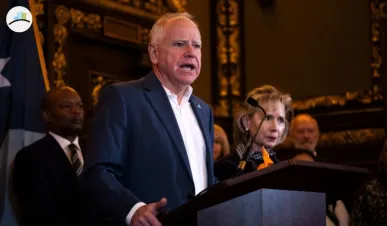
A federal judge has blocked Justice Department subpoenas targeting Minnesota Governor Tim Walz and other Democratic officials, turning a technical immigration investigation into a major political and constitutional fight. U.S. District Judge Patrick Schiltz ruled that the subpoenas were not mainly about finding evidence of a crime, but about pressuring Minnesota officials to help enforce federal immigration law and retaliating against them when they refused. Reuters reported that the order, issued on June 17 and made public on June 22, effectively halted the DOJ probe into whether state and local officials interfered with immigration enforcement.
What Did Judge Schiltz Decide?
Judge Patrick Schiltz quashed subpoenas issued to Tim Walz’s office and several other Minnesota state and local offices.
The Justice Department had sought information as part of an investigation into whether Minnesota officials obstructed or impeded federal immigration enforcement during a Trump administration immigration crackdown in the state. But Schiltz found that the government’s justification for the investigation was extremely weak. Reuters reported that the judge called the DOJ’s legal justification “risible.”
The ruling is significant because judges rarely step into grand jury subpoena disputes in such a forceful way. Here, Schiltz found that the subpoenas were being used for improper purposes rather than a legitimate criminal investigation.
Who Was Targeted By The DOJ Subpoenas?
The subpoenas targeted several prominent Minnesota Democratic officials.
According to AP, the subpoenas were sent to the offices of Governor Tim Walz, Minnesota Attorney General Keith Ellison, Minneapolis Mayor Jacob Frey, St. Paul Mayor Kaohly Her, and officials in Ramsey and Hennepin counties.
The Justice Department said it was investigating whether state and local officials obstructed law enforcement operations. But the judge concluded that the information sought had an “extremely weak to nonexistent” connection to any possible criminal violation.
That finding is why the ruling is being described as a major setback for the DOJ.
Why Were The Subpoenas Issued?
The subpoenas were tied to a broader immigration enforcement surge in Minnesota.
The Trump administration had accused Walz and other officials of encouraging resistance to federal immigration actions. Reuters reported that Walz had openly encouraged citizens to record ICE arrests and praised protesters opposed to the crackdown.
Federal officials argued that the investigation was about possible obstruction of federal operations. But state and local officials argued that the subpoenas were politically motivated and designed to punish them for criticizing immigration raids.
Judge Schiltz agreed with that broader concern.
Why Did The Judge Call The Subpoenas Retaliatory?
The core of the ruling is that the subpoenas appeared to be about political pressure, not criminal evidence.
AP reported that Schiltz found the “dominant purpose” of the subpoenas was to coerce Minnesota officials into assisting federal civil immigration enforcement and to harass and retaliate against them for failing to do so.
That sentence is the center of the case.
In simple terms, the judge said the DOJ was using legal tools to pressure political opponents and force cooperation with federal immigration policy. He also wrote that the Justice Department had struggled to identify a single plausible investigatory justification for the subpoenas.
Why This Ruling Matters Beyond Minnesota
This ruling matters because it raises a bigger question about how much power the federal government can use against state and local officials who disagree with its policies.
Immigration enforcement is mainly a federal responsibility. But states and cities are not automatically required to use their own resources to help enforce federal immigration law.
The Guardian reported that Schiltz also said the subpoenas violated the 10th Amendment, which protects state self-government in areas not assigned to the federal government.
That constitutional angle makes the ruling more important than a normal subpoena fight. It touches the balance of power between Washington and state governments.
What Was The Immigration Crackdown In Minnesota?
The subpoenas came after a tense period of immigration enforcement in Minnesota.
AP reported that tensions escalated in January as federal immigration officers clashed with protesters in the Minneapolis-St. Paul area. The situation became especially serious after the fatal shootings of Renee Good and Alex Pretti by federal immigration officers.
Those incidents sparked protests, criticism from local officials and a wider political fight over the Trump administration’s immigration tactics.
The DOJ subpoenas were issued in that climate, which is part of why Minnesota officials argued that the investigation was meant to intimidate critics.
What Did Tim Walz Say After The Ruling?
Tim Walz welcomed the decision.
AP reported that Walz called the ruling “a victory for the rule of law and our democracy.” He also accused the Justice Department of pursuing criminal investigations into the president’s political opponents.
Minnesota Attorney General Keith Ellison also praised the ruling. Reuters reported that Ellison said it should disturb Americans if the criminal justice system is being weaponized against people the president disagrees with.
Their response shows how politically charged this case has become. For Minnesota Democrats, the ruling is not only a legal win. It is also a public rebuke of the Trump administration’s approach.
What Did The DOJ Say?
The Justice Department defended its broader position.
According to Reuters, a DOJ spokesperson said the department takes unlawful obstruction of federal law enforcement operations seriously and would continue to act in compliance with the law.
That means the legal and political fight may not be fully over. The DOJ could continue to defend its approach, seek other legal routes or face more challenges from state and local officials.
But for now, the subpoenas in this case have been blocked.
Why People Are Searching “Judge Schlitz Blocks Walz Subpoena”
Many people are searching the judge’s name as “Judge Schlitz,” but the correct spelling is Judge Patrick Schiltz.
This happens often with breaking legal news because names spread quickly across headlines, social media and search engines. For SEO, it is useful to mention the typo once naturally, but the article should use the correct spelling throughout.
The ruling itself was issued by U.S. District Judge Patrick Schiltz, a Minnesota-based federal judge appointed by former President George W. Bush, according to Reuters.
What Does “Quashed Subpoenas” Mean?
To “quash” subpoenas means the court has blocked or canceled them.
In this case, it means the DOJ cannot use those subpoenas to force the Minnesota officials’ offices to produce the requested information.
That is why the ruling is a major blow to the investigation. If the subpoenas were central to the DOJ’s attempt to gather documents, quashing them limits what federal investigators can obtain through that route.
Why The Grand Jury Process Became A Major Issue
Grand jury subpoenas are powerful legal tools. They allow prosecutors to gather evidence during criminal investigations.
But Schiltz found that the DOJ was not using the process properly. AP reported that the judge wrote the department was not conducting a criminal investigation but was instead using the grand jury process for other unlawful purposes.
That is one of the most damaging parts of the ruling for the Justice Department.
It suggests that the court believed the subpoenas were not a normal investigative step. Instead, the judge viewed them as part of an effort to pressure and punish state officials.
What Happens Next?
The immediate result is that the subpoenas are blocked.
But the wider conflict between the Trump administration and Minnesota officials over immigration enforcement is likely to continue. AP reported that other legal fights tied to the immigration surge are still ongoing, including disputes over state investigations into incidents involving federal officers.
The DOJ may also face more scrutiny if courts continue to question whether investigations are being used for political purposes.
For Walz and other Minnesota officials, the ruling gives them a major legal victory. For the Trump administration, it is another court setback in a politically sensitive immigration battle.
MORE ARTICLES:
Final Takeaway
Judge Patrick Schiltz’s decision is a major ruling in the fight between the Trump administration and Minnesota officials over immigration enforcement. The court blocked subpoenas targeting Tim Walz and other Democratic leaders, finding that the DOJ’s actions appeared aimed at coercion, harassment and retaliation rather than a legitimate criminal probe.
The ruling matters because it goes beyond one state. It raises serious questions about federal power, state authority and whether criminal investigative tools can be used against officials who oppose a president’s immigration policies.
For now, the subpoenas are blocked, Walz and other Minnesota officials have claimed victory, and the Justice Department is facing sharp judicial criticism over how it handled the case.



