
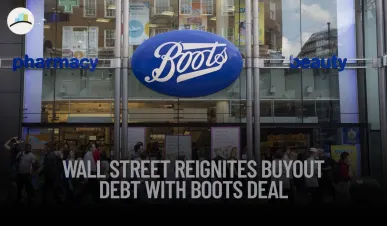
A coalition of top-tier investment banks, including JPMorgan, Goldman Sachs, Citigroup, Deutsche Bank, UBS, and Wells Fargo, has begun marketing a $4.25 billion debt package to fund the acquisition of British drugstore chain Boots by Sycamore Partners. This high-profile transaction is being seen as a litmus test for whether institutional investors are truly ready to re-engage with the leveraged finance market after a prolonged period of caution.
The debt issuance is a blend of approximately $2.25 billion in leveraged term loans and $2 billion in secured bonds. Market discussions have suggested tentative pricing in mid-July, with a more formal launch expected soon if investor interest aligns. While this news marks a return of optimism in dealmaking, it also surfaces strategic shifts in how banks approach high-risk financing amid ongoing competitive pressure from private credit firms.
More Articles:
Boots Buyout: A Strategic Catalyst in a Changing Credit Cycle
This $4.25 billion financing is not just about a single buyout; it is about narrative-shaping. After a sharp pullback in leveraged deal activity in 2023 and early 2024—largely due to interest rate volatility, credit downgrades, and tightening liquidity—this deal represents a broader signal: Wall Street is once again open for business.
Several dynamics make this debt sale particularly important:
-
Restoration of Syndication Confidence:
For more than 18 months, banks struggled with “hung debt”—leveraged loans and bonds they couldn’t sell after deal closes, forcing them to carry the risk on their own books. Successful execution of this Boots deal would mark a turning point, signaling that underwriting syndicates once again feel confident they can distribute risk. -
Reawakening Institutional Appetite:
Institutional investors, such as CLO managers and high-yield funds, have shown tentative interest in recent months, especially as economic indicators suggest inflation is moderating. If the Boots package prices well, it could revalidate the asset class’s appeal. -
Diversified Structure for Market Reach:
By splitting the package into loans and bonds, banks are addressing a wider risk-reward spectrum among buyers. The secured nature of the bonds and relatively senior loan tranches are designed to mitigate residual concerns about credit quality.
Strategic Implications: What This Means for Wall Street and PE Players
The Boots transaction reflects more than just a return to market—it underlines the strategic interplay between investment banks and private equity firms.
-
Banks Rebuilding Trust with PE Sponsors:
In underwriting this transaction, banks are reinforcing their relationships with sponsors like Sycamore Partners, who require dependable access to debt financing for large buyouts. The ability to execute deals at scale remains a differentiator in retaining private equity mandates. -
Repositioning After Private Credit’s Rise:
Over the past two years, direct lenders and private credit funds captured large chunks of the leveraged finance market, often funding entire buyouts. This move by banks can be read as a deliberate pushback—reasserting their dominance in syndicated lending and bond issuance. -
Liquidity Recycling for Bigger Pipeline:
Clearing the $4.25 billion from balance sheets will free up capital for upcoming financings. Multiple sources indicate that similar packages are in the works for future deals involving Apollo Global Management, KKR, and Silver Lake, with sectors ranging from healthcare to gaming and consumer retail. -
Yield Discipline vs. Competitive Risk:
One unspoken challenge: banks must price these instruments attractively without eroding their margins, especially given private credit’s tendency to undercut on terms. The Boots deal will serve as a pricing benchmark for future high-yield or leveraged loan issuances.
Banks are looking to sell $2.25 billion of term loans and $2 billion equivalent of bonds for Boots, to help finance its acquisition by US private equity firm Sycamore Partners, sources say https://t.co/7hYlqZ9y53
— Bloomberg (@business) July 14, 2025
Investor Signals and Market Sensitivities
If successful, the Boots financing will likely serve as a bellwether for a resurgent leveraged finance cycle. Analysts are particularly watching:
-
Final pricing spreads on bonds and loans
-
Participation rates from traditional institutional players versus alternative lenders
-
Appetite from European versus U.S. investors
-
The sequencing of other pending LBO financings in the pipeline
Should demand exceed expectations, Wall Street may accelerate other debt sales in the pipeline—many of which were paused or scaled down over the last year due to macro volatility.
Disclaimer:
This article is intended for informational purposes only and does not constitute investment advice. Procapitas does not provide personalized financial recommendations. Always consult a licensed financial advisor before making investment decisions. Information is based on publicly available sources as of June 2025 and Procapitas’ independent research and analysis.



