
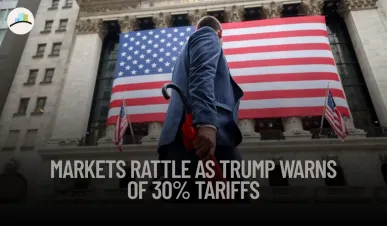
U.S. stock futures fell significantly following Donald Trump’s announcement of broad new tariffs. These include a 30% import duty on goods from the European Union and Mexico, set to take effect on August 1. The announcement came during a campaign speech in Michigan, where Trump accused foreign governments of "unfair trade tactics" and vowed to restore “American industrial dominance.”
S&P 500 futures dropped by as much as 0.8%, while Nasdaq and Dow futures also turned negative in overnight trading. Investors are increasingly concerned that the new tariff policy could escalate into a full-blown trade war, triggering a ripple effect across multiple sectors, including manufacturing, agriculture, and technology.
More Articles:
Global Supply Chains Bracing for Impact
The implications of these tariffs extend far beyond short-term market dips. Global supply chains, already strained from post-pandemic disruptions and geopolitical fragmentation, now face a fresh wave of uncertainty. Germany’s auto sector, in particular, is vulnerable. Data shows a 7.7% decline in U.S.-bound shipments from German carmakers in May 2025 compared to the same period last year.
Industries that depend on low-margin, high-volume international trade—such as pharmaceuticals, semiconductors, and industrial machinery—are at risk of margin compression. Copper, used widely in industrial wiring and electronics, is one of the commodities expected to be hit hardest. New tariffs could drive up costs, complicating production and potentially fueling domestic inflation.
U.S. firms, meanwhile, are reconsidering their logistics models. Many are accelerating their move toward regional supply chain diversification or “friendshoring”—shifting production to politically aligned or economically stable countries like Vietnam, India, and Mexico, despite Mexico now being included in the new tariff measures.
Wall Street’s Tepid Response Masks Deeper Risk
Despite the shock value of Trump’s rhetoric, some market participants believe the impact may be overstated. Wall Street has become somewhat desensitized to politically charged tariff threats, having weathered similar storms during Trump’s first term. The S&P 500 has gained over 25% since April 2025, even in the face of mounting geopolitical uncertainty.
However, market calm can be misleading. Institutional investors are cautiously reallocating capital into defensive sectors like utilities, healthcare, and infrastructure. Volatility indexes such as the VIX remain elevated, suggesting underlying nervousness. Moreover, the options market has seen a spike in hedging activity, especially in sectors with high exposure to trade flows.
The Federal Reserve, too, is watching closely. With inflation trending toward the 3% mark, additional cost pressures from tariffs could delay expected interest rate cuts. Fed officials have recently signaled a data-dependent approach, and if tariffs cause inflation to flare unexpectedly, the central bank may be forced to hold rates steady longer than markets anticipate.
Supply Chain Realignment Creating Opportunities
While risks are growing, so are opportunities. Companies that facilitate domestic manufacturing or support supply chain diversification are likely to benefit from the current environment. Logistics firms, railroads, domestic infrastructure providers, and automation companies are increasingly seen as strategic bets.
India and Vietnam, already major winners in the China+1 strategy, may attract further investment as multinationals seek alternatives to both China and now Mexico. U.S. companies with minimal international exposure are also seeing inflows as investors search for tariff-insulated earnings.
Additionally, gold and other traditional safe-haven assets have started gaining momentum as geopolitical friction adds another layer of market risk. Institutional flows into gold ETFs and Treasury bonds have increased modestly over the last week, indicating a subtle yet growing pivot toward capital preservation.
What to Watch in the Coming Weeks
Market volatility is expected to persist as investors seek clarity on the scope and enforcement of Trump’s proposed tariffs. Three major developments will shape near-term sentiment:
-
Q2 Earnings Season
Corporate earnings from major U.S. banks, manufacturers, and global tech giants will be closely analyzed for margin compression, forward guidance, and any commentary on supply chain exposure. -
Inflation Data (CPI – June 2025)
The next release of the Consumer Price Index will offer critical insight into whether tariffs are beginning to impact consumer prices. A higher-than-expected reading may stall hopes for Fed rate cuts later this year. -
Tariff Implementation Timeline
Although Trump set an August 1 start date for the tariffs, markets will scrutinize whether Congress or trade partners push back. Any sign of delay or softening could provide temporary relief.
Markets may rally if Trump signals a willingness to negotiate or if legal or diplomatic obstacles emerge to slow the tariff rollout. Conversely, escalation—such as retaliatory tariffs from the EU or supply chain disruptions—could provoke a sharper correction.
Disclaimer:
This article is intended for informational purposes only and does not constitute investment advice. Procapitas does not provide personalized financial recommendations. Always consult a licensed financial advisor before making investment decisions. Information is based on publicly available sources as of June 2025 and Procapitas’ independent research and analysis.



