
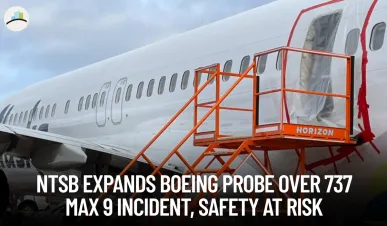
Imagine sitting in a window seat, cruising 16,000 feet above the ground, when suddenly a deafening roar tears through the cabin and a wall of wind erupts behind you. That was the nightmare passengers lived through aboard Alaska Airlines Flight 1282 this January — when a door panel ripped off a brand-new Boeing 737 MAX 9 mid-flight.
Now, six months later, the U.S. government wants answers. And not just about what failed — but why this keeps happening at Boeing.
The National Transportation Safety Board (NTSB) has launched a deeper probe, not only into the mechanical failure but into Boeing’s entire approach to safety, accountability, and internal culture. It’s not just about a door panel anymore. It’s about trust — the kind passengers, pilots, and airlines need to feel safe at 35,000 feet.
This isn’t Boeing’s first reckoning. Just a few years ago, the world grounded its 737 MAX 8 jets after two deadly crashes killed 346 people. At the time, Boeing vowed reform. It promised to fix its culture, double down on safety, and prevent future tragedies.
But the Alaska Airlines incident — though not fatal — shook confidence once again. And this time, it feels worse because Boeing had already been given a second chance.
The part that blew off? A door plug that had been reinstalled at Boeing’s Renton factory. Not a complex component — just a panel meant to be securely fastened. Yet somehow, multiple layers of quality control missed a glaring red flag.
Systemic failures led to a door plug flying off a Boeing 737 Max, NTSB says https://t.co/iGaqkYQv6v
— ABC13 Houston (@abc13houston) June 25, 2025
What’s Really Going Wrong at Boeing?
Here’s what insiders are worried about — and what the public isn’t hearing enough.
1. The Supply Chain Is a Mess
The company that built the fuselage, Spirit AeroSystems, has been struggling with quality issues for years. But Boeing isn’t just a customer here — it’s supposed to inspect, test, and verify before anything ever reaches the runway. When those steps fail, you’re gambling with lives.
2. Employee Voices Are Being Muzzled
Boeing’s legal team is reportedly restricting employee interviews with the NTSB. That alone raises red flags. Why limit your people from speaking to safety investigators if you have nothing to hide?
3. Regulators Are Fed Up
After the MAX 8 disaster, the FAA promised to never be caught flat-footed again. Now, with the NTSB growing increasingly frustrated and Congress circling, Boeing could face not just more oversight, but a full-on public grilling that could reshape how aircraft are certified and built in the U.S.
What This Means for You, Me, and the Industry
This isn’t just a Boeing story. It’s a global aviation story. Here’s what’s quietly unfolding behind the scenes:
-
Airlines Are Losing Patience: United and Alaska Airlines have both voiced concerns over delivery delays and mechanical issues. If airlines start losing faith, they’ll turn elsewhere — and Airbus is more than ready to welcome them.
-
Insurance Costs Will Skyrocket: Every incident adds to Boeing’s liability — not just financially, but reputationally. That means higher costs to build planes and possibly higher ticket prices for travelers.
-
The Jobs Ripple Effect: If regulators tighten their grip or major contracts get delayed, it won’t just affect Boeing — it could ripple down to tens of thousands of supplier jobs, engineers, and factory workers across the U.S.
More Article:
Déjà Vu with a Dangerous Twist
We’ve seen this movie before. Remember NASA’s Challenger disaster? Engineers raised red flags. Managers pushed forward anyway. The result was tragic. In Boeing’s case, the root issue seems eerily familiar — a company too focused on speed and stock price, and not enough on the bolts holding the plane together.
What’s at Stake Now?
The Alaska incident was a near-miss. But it may be Boeing’s last warning before something worse happens.
Experts say Boeing has a rare opportunity here — to open its doors, invite transparency, and listen to its engineers again. That could mean creating independent safety boards, bringing in whistleblower protections, and even letting airlines review internal audits.
But will the company take that road? Or will it hunker down and lawyer up?
If it’s the latter, the damage — to its brand, to public trust, and potentially to human life — could be irreversible.



