
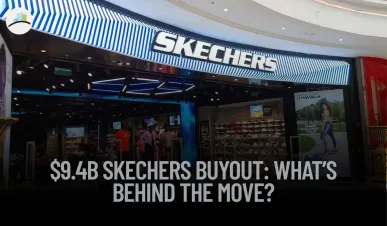
In a high-stakes move that reshapes the retail footwear landscape, 3G Capital is taking Skechers private in a deal valued at approximately $9.4 billion. The transaction, announced amid sustained pressure from escalating U.S.-China tariffs, values Skechers at $63 per share—a roughly 28% premium over its pre-deal trading level.
The deal structure allows shareholders the option to receive either an all-cash payout or a hybrid offer comprising cash and restricted private equity units in the new holding entity. The hybrid equity component will be capped at 20% of the total shareholder base. This structure provides liquidity for risk-averse investors, while giving long-term bulls exposure to private upside—albeit with limited flexibility.
More Articles:
Why Now? Tariffs and Market Fatigue
Skechers has been grappling with an increasingly complex global trade environment. Roughly 40% to 70% of its U.S.-bound footwear is sourced from China. With punitive tariffs imposed on imported Chinese goods—some spiking to 145%—Skechers has faced severe cost pressures, forcing the company to withdraw earnings guidance for the remainder of the fiscal year.
This regulatory volatility, coupled with Wall Street's waning patience for margin uncertainty, made the public market an increasingly hostile environment. Taking Skechers private removes the burden of quarterly earnings expectations and provides the breathing room needed to re-engineer its supply chain away from China without short-term shareholder scrutiny.
In essence, the deal reflects a calculated retreat from public visibility in favor of long-term operational transformation behind closed doors.
The Debt Stack: Leveraged but Manageable?
The transaction is being funded through a complex capital stack, including approximately $5 billion in senior secured debt, $3.3 billion in high-yield (junk-rated) bonds, and an equity injection from 3G Capital. Post-acquisition, Skechers is expected to carry one of the largest debt loads in the global apparel and footwear industry.
While 3G Capital is known for aggressive financial engineering, this deal marks a cautious balance between leverage and continuity. Skechers currently holds about $820 million in cash and has manageable existing debt levels, but interest coverage will be a critical watchpoint once the deal closes.
High leverage does introduce refinancing risk, particularly in a high-rate environment. But Skechers’ consistent free cash flow generation and global brand equity provide a foundation for eventual deleveraging—assuming execution goes as planned.
Strategic Approach: 3G Capital’s New Playbook?
Historically, 3G Capital’s deals—like Kraft Heinz—were characterized by cost-cutting, leadership shake-ups, and margin expansion at the expense of innovation. Interestingly, this deal marks a departure from that model.
Skechers’ current executive leadership, including CEO Robert Greenberg and President Michael Greenberg, is expected to remain in charge. This continuity signals that 3G may be betting not on a top-down overhaul, but on providing capital and strategic latitude for the brand to evolve organically.
This is a significant shift. Instead of imposing strict austerity, 3G appears to be allowing existing leadership to adapt the company’s cost base, supply chain, and international expansion strategy without the constraints of public market optics.
It also suggests that 3G views Skechers not as a turnaround, but as a high-performing brand that’s temporarily constrained by macro forces outside its control—most notably tariffs.
Market Impact and Investor Takeaways
Following the announcement, Skechers stock surged by more than 25%, reflecting investor enthusiasm for the buyout premium and relief from public-market fatigue. For many shareholders, the all-cash offer represents a clean exit from a stock that has underperformed in recent months due to tariff volatility.
However, the hybrid equity structure may appeal to institutional investors and insiders who believe in Skechers’ long-term brand trajectory and are willing to accept illiquidity in exchange for higher future returns.
From a broader market standpoint, this deal may signal renewed interest in high-cash-flow, consumer-facing companies as private equity targets—particularly those that are undervalued due to short-term macroeconomic pressures rather than business model flaws.
$SKX debt SOLD
— AT (@Arbtrader69) June 26, 2025
Skechers priced more than $6 billion in debt on Thursday to support its buyout by 3G Capital, in a sizable deal that showed how eager leveraged finance buyers are for any debt supporting a large merger or acquisition https://t.co/DW5gXAvz2S
Unseen Opportunity: Realigning Skechers for the Next Growth Cycle
Beyond headlines, the Skechers deal holds an underappreciated strategic dimension. In a world where athletic and athleisure brands are increasingly fighting for differentiated identity, Skechers is one of the few mid-tier brands with massive scale but low dependency on high-profile sponsorships or fashion cycles.
By going private, Skechers could reposition itself more aggressively in emerging markets, invest in supply chain localization, and expand e-commerce initiatives without public market friction.
Moreover, its extensive international reach—particularly in Latin America and Asia—gives it optionality that many U.S.-centric footwear brands lack. If 3G and Skechers leadership can coordinate effectively, the company could emerge from this buyout leaner, more agile, and better positioned to compete with both legacy players like Nike and rising direct-to-consumer disruptors.
Disclaimer:
This article is intended for informational purposes only and does not constitute investment advice. Procapitas does not provide personalized financial recommendations. Always consult a licensed financial advisor before making investment decisions. Information is based on publicly available sources as of June 2025 and Procapitas’ independent research and analysis.



