
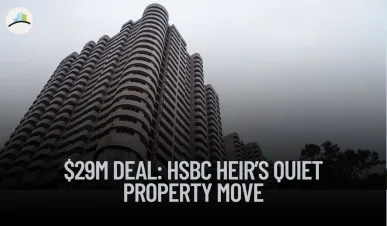
In a move that has raised eyebrows across Hong Kong’s real estate and financial sectors, Jeremy Wong Ka-chun—son of Peter Wong, Chairman of HSBC Asia-Pacific—has acquired four luxury apartments in the prestigious Hong Kong Parkview residential complex for approximately HK$231 million, or about USD 29 million. The transactions, carried out over the past quarter, were executed through a corporate vehicle registered in Wong’s name.
While not a headline-grabbing acquisition by conventional standards, the scale and timing of the purchase signal a calculated long-term strategy amid the worst property downturn the city has seen in nearly a decade.
More Articles:
Why the Timing Matters: Opportunity in a Depressed Market
Hong Kong’s luxury residential market has been under sustained pressure since 2019. Geopolitical tensions, emigration trends, declining demand from mainland Chinese buyers, and global interest rate hikes have all contributed to a steady decline in home values. Property prices are currently hovering at an eight-year low, and transaction volumes have remained sluggish even as the government introduced stimulus measures, including relaxed stamp duties and looser mortgage terms.
In this climate, Jeremy Wong’s purchases stand out not merely for their price tag, but for their precise timing. The acquisitions were made shortly after policy changes aimed at reviving buyer interest, suggesting an informed and possibly opportunistic decision to capitalize on market recovery signals before broader investor sentiment shifts.
Strategic Insight: More Than Just a Property Play
While the transactions could be interpreted as personal investments, a closer reading suggests a more layered strategy at work.
First, the use of a corporate entity to carry out the purchase is noteworthy. In wealth management and estate planning, this structure is commonly used to facilitate intergenerational asset transfer, protect anonymity, and enable more flexible financial planning. It reduces the exposure of the asset to personal tax liabilities, inheritance complications, or potential political or business entanglements.
Second, the Parkview properties—long associated with top-level executives, diplomats, and business elites—are not just prime residential real estate. They also serve as a form of social capital. Owning multiple units in the same complex can offer multi-generational living, long-term leasing options, or even consolidation into a larger customized residence in the future.
Third, the quiet nature of the acquisition underscores a recurring pattern among financial insiders: accumulate tangible, high-barrier assets during periods of cyclical undervaluation, then hold or optimize for yield as recovery unfolds. This strategy aligns closely with the behavior of high-net-worth families globally—particularly those with insider access to financial trends or regulatory timing.
Hidden Layers: Family Office Behavior and Policy Arbitrage
What sets this acquisition apart from routine real estate speculation is its underlying profile. Jeremy Wong is not only the son of HSBC Asia-Pacific’s chairman but is also a senior banker within the organization himself. Although there is no public suggestion of regulatory breach or conflict, this dual role raises subtle but significant considerations.
Executives in financial services typically have access to macro-level forecasting tools, privileged financing channels, and high-trust relationships with developers and legal advisors. These advantages can allow them to act ahead of policy or market shifts—often without violating any laws or corporate guidelines.
Moreover, the purchase hints at a broader trend seen among second-generation inheritors of Asian business empires. Rather than simply acquiring trophy assets, younger heirs are demonstrating a more measured approach—aligning asset purchases with tax efficiency, wealth continuity, and strategic diversification, hallmarks of mature family office strategies.
Wong’s acquisition could be interpreted as a quiet but confident bet not just on Hong Kong’s residential market, but on its longer-term geopolitical and economic resilience. That is a signal institutional players may begin to take more seriously.
Implications for the Market: A Turning Point or an Outlier?
The luxury residential segment in Hong Kong is notoriously opaque. Big-ticket purchases often go unreported until title deeds are disclosed. Yet each high-profile acquisition, especially by insiders or elite banking families, serves as a psychological pivot for investors and developers watching for signs of bottoming out.
While one transaction does not make a trend, the combination of timing, pedigree, and market conditions makes this case compelling. If other insiders follow suit—or if developers start to tighten inventory release—it could mark the early stages of a quiet recovery phase in a bruised but structurally sound market.
The question now is not whether Jeremy Wong’s move was smart. The question is: how many others like him are already positioning for the next cycle?
Disclaimer:
This article is intended for informational purposes only and does not constitute investment advice. Procapitas does not provide personalized financial recommendations. Always consult a licensed financial advisor before making investment decisions. Information is based on publicly available sources as of June 2025 and Procapitas’ independent research and analysis.



