
Iran War, Day 14: Hegseth Claims Iran's New Supreme Leader Is Wounded; 4 U.S. Crew Killed in Iraq Plane Crash
Friday, March 13, 2026
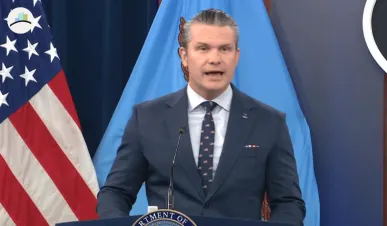
WASHINGTON / TEHRAN — Defense Secretary Pete Hegseth held a Pentagon press briefing on Friday claiming that Iran's new Supreme Leader, Mojtaba Khamenei, has been wounded and is "likely disfigured" — while simultaneously announcing what he called the highest volume of U.S. airstrikes over Iran yet, on Day 14 of the conflict known as Operation Epic Fury.
Hegseth's Claims About Mojtaba Khamenei
Hegseth told reporters at the Friday briefing that Mojtaba Khamenei has been "wounded and likely disfigured," asserting that Iranian leadership had been severely weakened by ongoing military operations. "Iran's leadership is in no better shape — desperate and hiding, they've gone underground, cowering — that's what rats do," Hegseth said.
Other Stories
-Chipotle's Tattoo Promotion: Earn Free Burritos on Friday the 13th If You Have Tattoos!
A key pillar of Hegseth's claim was the unusual nature of Khamenei's first public statement. Hegseth made these assertions without specifying what intelligence had led to his assessment. He pointed to the fact that Khamenei's first statement since taking power — issued Thursday — was a written message read by a state TV anchor, with no video or audio of the leader himself. "Iran has plenty of cameras and plenty of voice recorders. Why a written statement?" he said, adding: "His father: dead; he's scared, he's injured, he's on the run, and he lacks legitimacy."
What Iran says: Khamenei's written statement, issued a day before the briefing, vowed to continue the war. Iran has not confirmed the claims about Khamenei's injuries. Iran watchers noted that, from past experience, it would be unusual for the supreme leader to appear in an open forum like a public street rally even under normal circumstances. Iranian President Masoud Pezeshkian and other senior officials were visible at the Quds Day rally in Tehran on Friday, though Khamenei himself was not seen in public.
The Broader Conflict: Strikes and Scale
The U.S. and Israel have struck more than 15,000 targets during the war, Hegseth told reporters Friday — "well over 1,000 a day."
Hegseth also announced that "today will be yet again the highest volume of strikes that America has put over the skies of Iran and Tehran," with the number of sorties and bomber pulses ramping up further.
Joint Chiefs Chairman Gen. Dan Caine said U.S. and Israeli strikes have resulted in a 90% reduction in Iran's missile launches against Israel and Gulf allies. Hegseth said Iran's ballistic missile production capacity had been "functionally defeated" as of two days ago, with every company building missile components having been destroyed.
The three stated U.S. military objectives remain: neutralising Tehran's missile capabilities, destroying its navy, and permanently denying Iran the ability to develop nuclear weapons.
4 U.S. Service Members Killed in Iraq Plane Crash
The briefing comes as the U.S. military confirmed a separate tragedy. Four crew members were killed when a KC-135 military refueling plane crashed in western Iraq while supporting operations against Iran. Officials confirmed the loss was "not due to hostile fire or friendly fire."
The aircraft went down near Turaibil, along the Iraqi-Jordanian border. A second KC-135 involved in the same incident was damaged but landed safely. The Islamic Resistance in Iraq claimed responsibility for shooting down the plane, but CENTCOM said the loss was not due to enemy action. Rescue efforts were ongoing for the remaining two crew members.
It was the fourth publicly acknowledged U.S. aircraft crash connected to Operation Epic Fury. Earlier in the conflict, three F-15E Strike Eagles were shot down in a friendly-fire incident involving Kuwait, though all six crew members safely ejected.
The total death toll across the broader conflict now stands at over 1,200 Iranians killed, according to the Iranian Red Crescent Society. At least 10 U.S. service members have been killed in action, with an eleventh dying of a medical issue unrelated to combat. Deaths have also been reported in Lebanon, Israel, Kuwait, Iraq, the UAE, Bahrain, and Saudi Arabia.
Quds Day Rallies in Tehran Under Fire
A large explosion struck the Ferdowsi Square area in Tehran on Friday, where thousands had gathered for the annual Quds Day rally organized by the government. Israel had earlier warned it would target the area. Large crowds continued to march despite the explosions, chanting slogans and carrying posters of both Mojtaba Khamenei and his late father, Ayatollah Ali Khamenei, who was killed on the opening day of the war.
Background
President Trump announced "major combat operations" against Iran on February 28, with massive joint U.S.-Israel strikes targeting military and government sites. Iranian state television confirmed that Ayatollah Ali Khamenei was among those killed on the first day of strikes. His son Mojtaba was chosen to succeed him on Sunday.
US PENTAGON CHIEF RIDICULES IRAN REGIME LEADERS
— Hold My Beer News (@holdmybeernews) March 13, 2026
Pentagon chief Pete Hegseth claimed Iran's new Supreme Leader, Mojtaba Khamenei, is wounded and likely disfigured.
He said this during a press conference on Friday, March 13, 2026.
Hegseth mocked Iran's leadership, saying,… https://t.co/EsC3u8CUt3 pic.twitter.com/OgTaLML475
Hegseth had initially predicted the war could last between three to eight weeks. Trump has since given conflicting signals on the timeline, saying both that the war would end "soon" and that the U.S. had "unlimited ammunition and plenty of time."



