
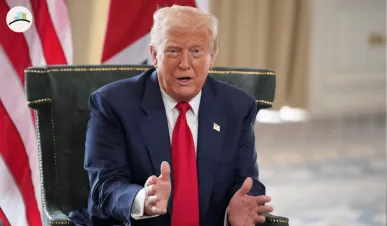
U.S. President Donald Trump said on June 10, 2026, that he is “not looking to renew” the United States‑Mexico‑Canada Agreement (USMCA) with Canada and Mexico as its scheduled review approaches, raising fresh uncertainty in North American trade relations. Trump argued that the United States “doesn’t need anything” from Canada or Mexico, a stance that contrasts with economic leaders who say the trade pact supports nearly $2 trillion in annual commerce and helps keep tariffs low on goods traded across the continent.
Trump’s Statement on USMCA Renewal
President Donald Trump said Wednesday that he is not planning to renew the United States‑Mexico‑Canada Agreement (USMCA) — the trade deal that replaced the North American Free Trade Agreement (NAFTA) in 2020. Speaking in the Oval Office, Trump said the U.S. does not “need anything that Canada has” or “anything that Mexico has,” and suggested the country’s trade partners benefit more from the deal than the United States does.
USMCA — also known as CUSMA in Canada and T‑MEC in Mexico — is up for a mandatory review on July 1, 2026, six years after it came into force. Normally, the three countries would agree to extend the pact for another 16 years, but Trump’s comments signal that the U.S. might instead let it lapse into a system of annual reviews. If that happens, the trade deal would remain in effect but without a long‑term renewal.
What Trump Said About the Deal
Trump reiterated his long‑standing criticism of NAFTA and the way he believes the agreement impacted U.S. manufacturing and trade balances. He said that while he considers USMCA better than NAFTA because it includes a mechanism for renewal or exit, he is unsure if he will extend it beyond the current cycle. “We don’t need anything that Canada has, we don’t need anything that Mexico has, but they need everything that we have,” Trump told reporters.
Implications for Trade With Canada and Mexico
USMCA has played a central role in facilitating tariff‑free trade in goods across North America. Under the deal, most Canadian and Mexican exports to the U.S. avoid high tariffs, keeping consumer prices more stable and supporting integrated supply chains, especially in automotive, agriculture, and energy sectors. Trump’s position could shift this long‑standing trade framework toward shorter, annual review cycles, rather than a long‑term renewal — a move many economists say would increase uncertainty for businesses that rely on consistent rules.
Reactions From Canada and Mexico
Canadian and Mexican officials have signaled that they want to extend the deal for its full term, emphasizing how critical stable trade relations are to their economies. Canadian Trade Minister Dominic LeBlanc and Mexico’s secretary of economy Marcelo Ebrard have written to U.S. counterparts pushing for a 16‑year renewal. Economists in both countries note that disruption to USMCA could lead to higher consumer costs, tariff barriers, and supply‑chain fragmentation if negotiations become protracted.
MORE ARTICLES:
What Happens Next
If the United States formally chooses not to renew the pact by the July 1 deadline, USMCA will still stay in place under an annual review system for up to a decade, giving lawmakers and officials more time to decide on its long‑term future. Formal talks between the U.S. and Mexico are already scheduled for later this month, while Canada has not yet begun formal bilateral negotiations with Washington. Market observers say the outcome of these talks will be closely watched, as changes could affect industries from cars and lumber to agriculture and energy.
Economic Considerations
Trade policy experts say USMCA has been a cornerstone in attracting investment and reducing trade barriers in North America since it took effect. Many businesses rely on its tariff protections and clear regulatory frameworks. Agricultural and manufacturing groups in the United States have even argued that a full 16‑year renewal would help provide long‑term stability to farmers and supply chains tied to Canadian and Mexican markets, even as political leaders debate the trade deal’s future.



