
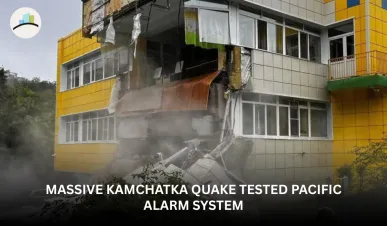
When the Ocean Roars: What the 8.8 Kamchatka Quake Teaches Us
On July 30, 2025, a magnitude‑8.8 earthquake struck near Russia’s Kamchatka Peninsula—one of the most powerful quakes recorded in decades. Though coastal regions from Japan to Hawaii and even South America were warned, the impact turned out surprisingly muted. Yet beneath the calm lies a story about preparedness, overstated fears, and long-term shifts still to come.
Tsunami Waves Hit U.S. Coast
— Gossip Lanka News (@gossiplanka) July 31, 2025
After Massive 8.8 Quake Off Russia
Tsunami waves have reached the U.S. West Coast after a powerful 8.8 magnitude earthquake struck off Russia’s Kamchatka Peninsula. The quake, which hit at 11:25 a.m. local time Wednesday, … https://t.co/Ma1jsJO6Fj
Why It Matters
-
Rare magnitude, shallow depth, wide ripple effects: At just ~12 km beneath the ocean floor, the quake generated tsunami alerts across the entire Pacific rim.
-
Risk communication under scrutiny: Massive evacuations and flight cancellations (Japan, Hawaii, Chile) contrasted with minimal damage—highlighting a growing mismatch between warning systems and measurable threats.
-
Symbol of geological volatility in geopolitically sensitive zones: The seismic event triggered volcanic activity at Klyuchevskoy, reminding us these regions carry multi-hazard potential.
MORE ARTICLES:
What’s Not Being Discussed Enough
1. Economic Disruptions Beyond Coastal Washouts
Flight cancellations and port shutdowns rippled through trade and tourism economies—from Hawaiian shellfish exports to logistics chokepoints in Japan. Such disruptions, even if short-lived, reveal hidden vulnerabilities in global supply chains tied to seismic zones.
2. Tsunami Warning System Fatigue
Frequent large-scale alerts with low or negligible impact may lead to public complacency. Without better calibration, warning fatigue could pose a future risk—particularly in places like Japan and Chile.
3. Volcanic – Seismic Domino Effect
This quake coincided with renewed eruption at Klyuchevskoy volcano, illustrating how tectonic events can cascade into volcanic crises. Few preparedness plans integrate multi-hazard dynamics—for which Kamchatka now serves as a real-world case study.
Hidden Risks & Emerging Opportunities
| Hidden Risks | Under-appreciated Opportunities |
|---|---|
| Erosion of public trust if warnings repeatedly overestimate impact | Data-driven recalibration of early warning algorithms (e.g., AI-enhanced models) |
| Exposure of critical nodes—power plants, ports, airlines—to seismic downtimes | Reinforced building codes and inversion of economic flows into preparedness infrastructure |
| Economic cost of false alarms in tourism-dependent regions | New investments in coastal analytics, evacuation modeling, and real-time crowd movement tracking |
Historical Echoes & Expert Insight
-
The 1952 Severo-Kurilsk quake (M~9.0) caused devastating tsunamis and over 2,300 fatalities. Today's poorly felt comparable quake produced only minor waves.
-
Modern seismic models show that energy release grows exponentially with magnitude increments—a 0.3 higher magnitude releases twice as much energy, explaining why M9 quakes are so catastrophic.
-
Tsunami protocols post‑2011 Japan have become more conservative—but may now require refinement to avoid sociocultural backlash.
Final Takeaway
This seismic event shows that the combination of technical over-warning and less-damaging than predicted impact may erode credibility in disaster-warning systems. At the same time, it highlights a real need for multi-hazard integration, economic resilience, and improved public trust. Despite its size, the quake offers a better opportunity for adaptation than destruction—if authorities and experts read between the waves.



