
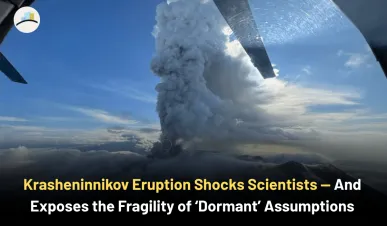
A Sleeping Giant Wakes After 600 Years
On August 3, the Krasheninnikov volcano on Russia’s far eastern Kamchatka Peninsula erupted for the first time in roughly six centuries. What makes this more than a dramatic natural event is how little it was expected. Krasheninnikov had been labeled dormant—quiet for so long that modern instruments barely tracked it. And yet, in a matter of hours, it roared back to life, spewing lava and volcanic ash several kilometers into the sky.
This eruption didn’t happen in a vacuum. Just days earlier, a powerful 8.8-magnitude earthquake struck off the Kamchatka coast, followed by strong aftershocks. While experts haven’t confirmed a direct cause-effect link, history tells us that seismic events often destabilize nearby magma chambers. That makes this a textbook example of how one natural event can trigger another—and how interconnected Earth’s systems are, especially in geologically active zones like the Pacific Ring of Fire.
🚨🇷🇺 Meanwhile at Mt Krasheninnokov, Russia
— Concerned Citizen (@BGatesIsaPyscho) August 3, 2025
This volcano hasn’t erupted for hundreds of years. Now it just did.
Billions more tonnes of natural Co2 spewing into the atmosphere, highlighting how delusional Man Made Climate Change is.
More significantly it’s yet ANOTHER… pic.twitter.com/jFtb1A4Fjd
Seismic Dominoes and Volcanic Pressure
Volcanic eruptions are rarely spontaneous. Magma doesn't suddenly appear—it builds, slowly, over decades or centuries. What the recent Kamchatka earthquake likely did was loosen the last pieces holding Krasheninnikov’s system together. The fault line activity may have unsealed rock barriers or changed pressure balances deep below the surface. This wasn’t just a volcanic eruption. It was a chain reaction—a reminder that what happens underground never stays isolated.
Why does that matter? Because if one long-dormant volcano can blow, others might not be as quiet as we think. Many "inactive" volcanoes globally—especially in Indonesia, Alaska, and Chile—sit in similar tectonic environments. If a major seismic event rattles their region, we could be looking at a series of geological surprises that disrupt lives, travel, and even economies.
MORE ARTICLES:
Aviation Disruption and Ashfall Risk Are Just the Start
Though Krasheninnikov sits inside a nature reserve, far from major settlements, its eruption isn’t without real-world impact. Ash clouds have already reached the upper atmosphere and are being tracked by aviation authorities. Flights are being rerouted as volcanic ash poses a severe hazard to jet engines, potentially grounding or delaying air traffic across the North Pacific—one of the busiest air corridors in the world.
There's also a less discussed concern: ash can affect climate. If large enough volumes reach the stratosphere, they reflect sunlight and temporarily cool the Earth. It’s too early to know if Krasheninnikov will produce enough material to shift temperatures, but the possibility is there—especially if this is the beginning of a longer eruptive phase, or if neighboring volcanoes follow suit.
What This Signals for the Future of Earthquake-Volcano Monitoring
Krasheninnikov's sudden eruption is forcing scientists to rethink how they classify risk. Dormancy, it turns out, is not safety—it’s silence, not absence. This event may trigger renewed investment in real-time geological monitoring, not just in active zones, but in so-called “quiet” systems. Governments and research institutions may need to upgrade satellite imaging, deploy more seismographs, and prioritize modeling that considers multi-event interactions.
There’s also a policy angle. Natural disaster readiness often focuses on the last known hotspot. But Krasheninnikov’s eruption shows that being prepared means expecting the unexpected—especially in sparsely populated areas where infrastructure and emergency response are minimal. Russia avoided major disaster this time, but the next surprise might not erupt in an uninhabited reserve.
Why This Story Matters
The eruption of Krasheninnikov isn’t just a geological oddity. It’s a reminder of how fragile our assumptions about nature really are. When a volcano stays silent for centuries, we treat it like a relic—dormant, safe, forgotten. But under the surface, the pressure never really stops building. This was a wake-up call. Not just for scientists and governments, but for all of us who live on a planet where even the oldest threats can suddenly come roaring back.



