
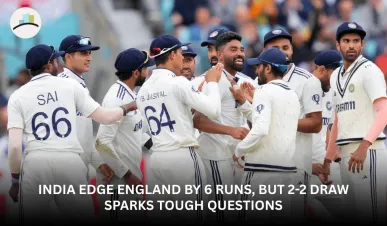
In a tense finale at The Oval, India pulled off a narrow six-run victory over England, levelling the five-match Test series at 2-2. While the match delivered on drama and cricketing brilliance, the broader implications of this result extend far beyond the scoreboard. From India’s overseas Test strategy to England's "Bazball" vulnerabilities, and the economic ramifications of bilateral draws in the broadcast era, this deadlocked series could influence cricketing policy on both sides.
That's a wrap! What a nail-biting finish at The Oval. India wins by 6 runs in the final Test to level the series 2-2! Mohammed Siraj with a heroic performance to seal one of India's narrowest and most famous Test victories. What a series this has been! #INDvENG #TestCricket #Oval pic.twitter.com/cbECHnZESa
— Anshu Singh (@akki_diamond) August 4, 2025
Why this narrow win matters
The six-run margin is one of the closest in recent India-England Test history, capping off a series that oscillated wildly in momentum. However, beneath the thrilling surface lies a story of missed dominance. India had led the series 2-1 before the postponed fifth Test in 2022 was rescheduled to this summer. That delay allowed England to regroup under the new McCullum-Stokes axis, bringing with them the Bazball approach—a hyper-aggressive, unorthodox strategy that was both thrilling and, at times, reckless.
India’s win at The Oval suggests that their more traditional, methodical style can still counter England’s Bazball, but the series draw reflects inconsistency. Jasprit Bumrah’s fiery spells, Rohit Sharma’s calculated leadership, and Rishabh Pant’s counter-attacks all worked in bursts, but the team’s inability to close out the series decisively raises questions about depth, especially in overseas conditions.
What's not being talked about: India’s fractured overseas dominance
Since 2021, India’s ambition has been clear—win overseas. The 2021-23 World Test Championship (WTC) cycle included historic wins in Australia and England, yet the follow-through has faltered. Drawn series against South Africa and England in two years reveal that India lacks consistency on foreign soil, despite an experienced core.
More concerning is India’s middle-order fragility. While Yashasvi Jaiswal and Virat Kohli provided pockets of resistance, collapses in key innings suggest a systemic issue: India’s Test batting isn’t evolving quickly enough to dominate new-age bowling tactics on faster tracks. If not addressed, this could cost them dearly in the 2025 WTC final push.
The hidden opportunity: A new Test narrative for India
Despite the draw, India has found in this series several strategic green shoots. Kuldeep Yadav’s resurgence adds mystery to the spin department. Sarfaraz Khan’s debut showcased India’s bench strength. More importantly, this series forced Rohit Sharma to adapt from a defensive to a flexible, risk-tolerant leadership model—a shift that could transform India’s Test match tactics.
India’s selectors now have a chance to accelerate generational transition. With Cheteshwar Pujara and Ajinkya Rahane already phased out, the time is ripe to blood players like Abhimanyu Easwaran, Rajat Patidar, or Rinku Singh in the red-ball format before the away tours to Australia and South Africa.
England’s gamble and its broader economic context
England’s embrace of Bazball has drawn praise and criticism alike. While it injects life into the traditional format and revives viewership, it’s also prone to collapses under pressure. Critics argue that the brand has entertainment value, but not longevity. A 2-2 result at home may make the ECB reconsider the balance between entertainment and competitiveness.
From an economic lens, Test cricket draws are double-edged swords. While thrilling finishes like The Oval’s boost short-term engagement and OTT viewership, broadcasters prefer series victories—they provide clear narratives and marketing material. With India's board (BCCI) set to renegotiate media rights next year, this result could weaken the 'India abroad' premium that broadcasters rely on.
The geopolitical cricket diplomacy factor
This drawn series arrives at a time of shifting cricketing alliances. India’s influence at the ICC remains undisputed, and series results affect future bilateral tour structures. A drawn series with England—its closest soft-power cricketing partner—may push the BCCI to reexamine how many marquee away tours are feasible in the next FTP cycle. With growing influence in South Asia, India may shift attention to hosting power-heavy bilateral series, focusing on dominance at home where results are more assured.
Historical echoes: Déjà vu from 2002 and 2012
Interestingly, this 2-2 draw echoes the 2002 series when India under Ganguly squared the series in England but failed to clinch dominance. A decade later, India’s 2012 collapse in England sparked long-term structural changes in team selection and domestic reform. If the BCCI reads this 2-2 draw as a similar inflection point, deeper changes—especially in India’s Test preparation calendar may follow.
More Articles:
Conclusion
The final Test win at The Oval gave India fans reason to cheer, but the series outcome serves as a mirror. It reflects both progress and stagnation. Unless key lessons are drawn from this hard-fought draw, the same inconsistencies could haunt India in their 2025 WTC campaign. For England, Bazball remains a work-in-progress—thrilling yet incomplete.