
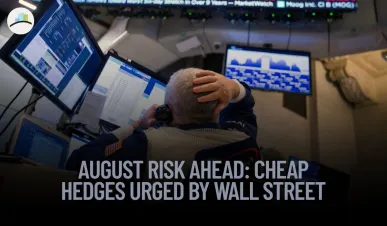
Wall Street's most prominent trading desks, including Goldman Sachs, JPMorgan, and Citadel Securities, are advising clients to consider low-cost equity hedges heading into August—a historically volatile month for markets. With the S&P 500 hovering near record highs and the Cboe Volatility Index (VIX) sitting at one of its lowest levels in months, the cost of downside protection is unusually cheap.
These recommendations stem from growing concerns that the current calm may be deceptive. While equity markets have enjoyed a strong rally since April, surging nearly 28%, analysts believe this rally could be vulnerable to late-summer risks—particularly those triggered by liquidity thinning, macroeconomic data shocks, and lingering policy uncertainty.
More Articles:
Tariffs, Fed Signals, and Economic Data Are Major Triggers
Key among the anticipated risk events is the August 1 trade deadline, where new tariff decisions could strain global supply chains, particularly if geopolitical tensions escalate. At the same time, traders are closely watching the Federal Reserve’s July 30 policy decision and upcoming U.S. employment data, which will offer signals about the path of interest rates and labor market strength.
Seasonal patterns further support the caution. Historically, August and September rank among the most volatile months for equities. With many institutional desks on summer schedules and lower trading volumes, even small economic surprises can lead to outsized market reactions.
VIX Call Options and SPX Puts — The Tools of Choice
Wall Street strategists are recommending a strategic mix of VIX call options and S&P 500 put options to hedge portfolio risk. VIX calls serve as a protective instrument that appreciates when market volatility rises. When paired with short-dated S&P puts—which provide downside protection or income depending on strike structure—investors can create an efficient hedge with minimal drag on performance.
This hedging strategy is not intended for outright bearish bets. Instead, it's a way to preserve gains and guard against potential downside without liquidating equity positions. Traders note that implied volatility is still low, making this an opportune time to lock in protection before pricing adjusts to reflect future risk.
Bank of America strategists are suggesting a way to protect against any sudden bouts of turbulence in August, a historically choppy time for a stock market that’s been unusually calm in recent weeks https://t.co/I0Gw1eP5gg
— Bloomberg (@business) July 31, 2025
Procapitas Insight — Tactical Hedging in a Complacent Market
The current market landscape shows signs of complacency, particularly as volatility metrics remain muted despite looming uncertainties. Retail flows, automated trading strategies, and persistent institutional optimism have suppressed short-term fear indicators, but not eliminated underlying risk.
Strategists like Scott Rubner from Citadel emphasize the value of preemptive positioning, especially in mid-August when liquidity deteriorates and market fatigue sets in. This is not a call to exit equities, but rather to engage in tactical hedging that allows investors to stay invested while limiting exposure to extreme downside scenarios.
For sophisticated investors, especially asset managers with performance targets tied to quarter-end benchmarks, this period presents a rare window to acquire cost-effective protection. If market turbulence fails to materialize, the cost is limited. But if it does, the insurance pays off.
Disclaimer:
This article is intended for informational purposes only and does not constitute investment advice. Procapitas does not provide personalized financial recommendations. Always consult a licensed financial advisor before making investment decisions. Information is based on publicly available sources as of June 2025 and Procapitas’ independent research and analysis.



