
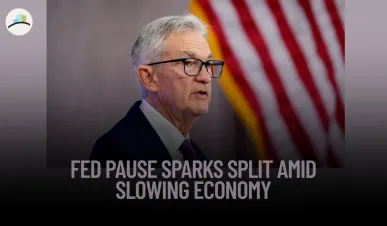
In a closely watched decision on July 30, 2025, the U.S. Federal Reserve kept interest rates steady for the fifth consecutive time, holding the target range for the federal funds rate at 4.25% to 4.50%. While this move was broadly anticipated, the real surprise came from inside the Fed itself—two governors, Christopher Waller and Michelle Bowman, dissented and voted in favor of a 25 basis-point rate cut.
More Articles:
This marked the most significant internal disagreement within the Federal Open Market Committee (FOMC) since 1993. While the Fed maintained a relatively neutral tone, Chair Jerome Powell acknowledged signs of economic slowing and reiterated the central bank’s commitment to data dependency. He firmly stated that it is still too early to declare victory on inflation, and the committee requires more confidence that price pressures are sustainably declining.
The updated policy statement also removed prior language describing the U.S. economy as expanding “at a solid pace,” replacing it with more cautious phrasing that economic activity has “moderated.”
Economic Growth Cools Beneath the Surface
While the headline U.S. GDP growth rate of 3 percent in the second quarter may appear impressive, much of this was driven by a decline in imports ahead of incoming tariffs. Core growth, excluding inventory and trade adjustments, is notably weaker.
Private consumption has lost momentum, and capital expenditure remains tepid. Adjusting for these factors, underlying economic activity in the first half of 2025 points closer to a subdued 1.25 percent pace. This moderation has not gone unnoticed by the Fed, which now views the current phase of expansion as fragile, with household demand and business investment facing increasing headwinds.
The labor market, however, remains robust. Private-sector payroll growth in July exceeded expectations, and wage inflation appears to be cooling gradually. Still, services inflation—particularly in healthcare and housing—remains sticky, justifying the Fed's restraint in prematurely cutting rates.
Inflation Risks Persist Amid Trade Tensions
One of the most significant external risks affecting inflation dynamics is the evolving trade policy environment. The Trump administration’s imposition of new 25 percent tariffs on imports from India, Brazil, and select commodity producers is beginning to affect input prices across multiple sectors.
These trade measures, aimed ostensibly at protecting U.S. jobs and manufacturing, could have unintended inflationary consequences. Higher import costs for materials such as metals, semiconductors, and generic pharmaceuticals may filter into consumer prices over the coming months.
The Federal Reserve acknowledged that while inflation is trending downward overall, global factors such as supply chain disruptions and trade policy could pose upside risks. This complicates the path toward achieving the Fed’s 2 percent inflation target on a durable basis.
Markets React Cautiously as Fed Holds Ground
Following the Fed announcement, U.S. equity markets displayed a cautious reaction. The S&P 500 dipped slightly, the Dow Jones Industrial Average fell by around 0.4 percent, and the Nasdaq Composite ended marginally higher. The bond market, meanwhile, reflected reduced expectations for a September rate cut, with futures pricing in less than a 50 percent probability—down from nearly 65 percent a day prior.
The yield on 10-year U.S. Treasuries ticked upward, reflecting the market's belief that rates may stay higher for longer than previously anticipated. The U.S. dollar strengthened modestly against major currencies, supported by Powell’s guarded tone.
Sector-wise, defensive equities such as utilities and healthcare outperformed, while rate-sensitive segments like real estate and financials came under pressure. Technology stocks, buoyed by strong earnings from Microsoft and Meta earlier in the week, held firm but showed signs of consolidation.
Powell cites inflation risk as Fed holds interest rates steady https://t.co/JNtmU4piL4
— The Edge Singapore (@readtheedge_sg) July 30, 2025
Strategic Insight – A Stagflation Setup?
What is unfolding is not a classic slowdown, but something more complex. The combination of persistent inflation and softening growth—a classic setup for stagflation—is now in play. Powell’s careful messaging suggests the Fed is increasingly aware of this risk but is unwilling to act too early and fuel inflation expectations.
This makes the path for monetary easing narrower and more reactive. Markets may need to reprice the “rate cut optimism” narrative that dominated the first half of 2025. Investors should prepare for a longer period of elevated real interest rates, which would compress equity valuations and challenge leverage-heavy business models.
Strategically, investors may benefit from reducing exposure to cyclical sectors and high-beta stocks while increasing allocations to cash-generating, dividend-paying companies in defensive sectors. Bond allocations should be tilted toward shorter duration, and high-quality credit is likely to outperform riskier instruments in a range-bound rate environment.
Disclaimer:
This article is intended for informational purposes only and does not constitute investment advice. Procapitas does not provide personalized financial recommendations. Always consult a licensed financial advisor before making investment decisions. Information is based on publicly available sources as of June 2025 and Procapitas’ independent research and analysis.



