
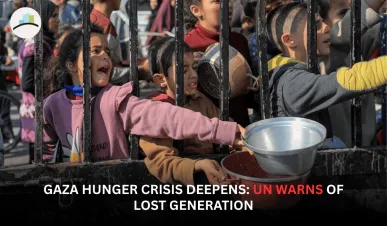
The war in Gaza has been waged with missiles, drones, and airstrikes — but its deadliest weapon may be hunger. As the United Nations rings alarm bells, data shows child malnutrition rates in Gaza have doubled since January, with nearly 9 in 10 children under five now suffering from nutrient deficiencies. This is not just a health emergency — it's the beginning of a generational collapse.
A Crisis Born of War—and Strategy
While hunger is often a tragic side effect of war, in Gaza, it is becoming a calculated outcome of military and political decisions. Israeli operations, particularly around the southern city of Rafah, have effectively choked off humanitarian corridors. The Rafah crossing into Egypt, once a crucial lifeline for aid, has remained largely closed.
Fuel shortages — due to restrictions — have shut down bakeries, water purification plants, and hospital generators. Markets are empty, not only of food but also of people — either displaced or too hungry and exhausted to buy even what's left.
"This is a collapse of the humanitarian ecosystem," says a UN humanitarian officer who spoke under anonymity. "There’s no safe zone, no predictable aid access, and no recovery window for malnourished children."
Malnutrition’s Hidden Toll
What’s often lost in daily conflict reporting is that malnutrition is not simply about being hungry. When sustained, especially in early childhood, it leads to stunting, developmental delays, and permanent brain damage. This severely limits a child’s ability to learn, work, and thrive.
Moreover, micronutrient deficiencies — such as lack of iron, iodine, or Vitamin A — increase vulnerability to infection and raise the risk of death even from treatable illnesses like diarrhea or pneumonia.
Experts warn that Gaza is now breeding an entire generation of physically and cognitively impaired children. And the consequences of this crisis won't stop at Gaza's borders.
The Economic Time Bomb
Gaza’s pre-war economy was already under duress, with youth unemployment hovering around 65%. A mass of undernourished, uneducated children entering adulthood will further crush the region’s productivity. A lost generation isn't just a humanitarian tragedy — it's an economic one that could take decades to recover from.
Moreover, reconstruction efforts — once the war ends — will be undermined if there's no skilled workforce left. Economists warn this could lead to a dependency loop where Gaza remains trapped in a cycle of aid without development.
MORE ARTICLES
The Politics of Humanitarian Access
Why hasn't more aid arrived? Partly due to logistical hurdles and the destruction of access routes. But there’s a deeper political undercurrent. Israel fears that aid, if unmonitored, could be diverted by Hamas. Conversely, Palestinian authorities and international NGOs argue that Israel is using starvation as a war tactic — an accusation Israel strongly denies.
The result is a paralysis in decision-making, where humanitarian access is being negotiated like a ceasefire, delaying relief in real-time.
“Starvation should never be a bargaining chip,” says former UN Relief Coordinator Jan Egeland. “But right now, that’s exactly what it is.”
Global Fatigue — and Moral Complicity
With Ukraine, Taiwan, Sudan, and now Haiti dominating global attention, Gaza’s crisis is fading from donor priorities. Several European countries have cut or paused aid, citing internal budget constraints or lack of trust in aid accountability on the ground.
This "donor fatigue", while understandable, is also morally dangerous. The world risks becoming complicit — not through action, but through inaction.
In democracies, public opinion is also starting to shift. Graphic images of malnourished children are triggering growing criticism of arms sales and diplomatic ties with Israel, particularly in Western capitals.
Final Thoughts
Gaza is in crisis — not just militarily, but morally. The question now isn't just about stopping the war. It's about whether the world will allow hunger to become a tool of war, and in doing so, normalize a future where malnourishment becomes the legacy of modern conflict.



