
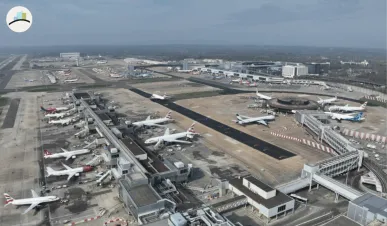
A routine night of arrivals at one of the UK’s busiest airports turned into a major aviation disruption after multiple aircraft were forced to declare emergencies when London Gatwick Airport’s runway became unavailable.
At least nine passenger aircraft reportedly declared low-fuel emergencies after a plane problem on the runway prevented incoming flights from landing normally.
The incident created a tense situation in the skies above Gatwick, with aircraft forced to circle while waiting for the runway to reopen.
Several flights were diverted to other airports as crews worked with air traffic controllers to manage the disruption.
What Happened at London Gatwick Airport?
The disruption began after a British Airways aircraft experienced a technical issue while on the runway.
The aircraft reportedly became unable to move normally, leading emergency crews to attend the scene.
Because Gatwick operates primarily with one active runway at a time, any major blockage can have an immediate impact on arriving and departing flights.
The runway closure created a backlog of aircraft approaching the airport.
An issue at Gatwick as nine (9) flights originally bound for the London airport are currently squawking 7700 (likely due to low fuel). We are working to learn more. https://t.co/HsHBhiVnxD pic.twitter.com/cHSUBcbZlv
— Flightradar24 (@flightradar24) July 14, 2026
Why Did Planes Declare Emergencies?
The aircraft did not declare emergencies because of problems with their own planes.
The issue was linked to the delay caused by the runway closure.
As aircraft remained in holding patterns waiting for permission to land, some began approaching fuel limits.
Pilots can declare a low-fuel emergency when they need priority handling from air traffic control to ensure the aircraft lands safely.
The declaration allows controllers to prioritise those aircraft over normal traffic.
Flights Diverted After Gatwick Disruption
With the runway unavailable, several flights were redirected to alternative airports.
Some aircraft were diverted to locations including:
- London Stansted
- London Luton
The disruption affected passengers travelling from popular holiday destinations, with some facing unexpected delays after long journeys.
Why Is Gatwick Vulnerable to Runway Problems?
London Gatwick is one of the UK’s busiest airports and operates differently from many major international airports.
Although it has two runways, the airport normally operates with only one active runway because the runways are too close together for simultaneous use under normal conditions.
This means a problem affecting runway availability can quickly create widespread disruption.
A single aircraft unable to clear the runway can impact:
- Incoming flights
- Departures
- Connecting passengers
- Airline schedules
Passenger Impact During Gatwick Airport Chaos
For passengers, the disruption meant uncertainty while aircraft waited for updates.
Travellers faced:
- Delayed arrivals
- Longer flight times
- Possible diversions
- Missed connections
Airport disruptions often create a chain reaction because aircraft and crews operate on tightly planned schedules.
A delay at one airport can affect flights across an airline network.
MORE ARTICLES:
British Airways Plane Technical Issue
The initial problem involved a British Airways aircraft that experienced a technical issue while at Gatwick.
Emergency services attended the aircraft, and passengers were able to leave safely.
The exact technical cause has not been publicly detailed.
Could This Have Become a Safety Risk?
Aviation experts emphasise that declaring a low-fuel emergency is a safety procedure, not necessarily a sign that an aircraft is in immediate danger.
Pilots and air traffic controllers regularly train for situations where weather, technical issues or airport restrictions affect operations.
The purpose of the emergency declaration is to ensure aircraft receive priority before fuel becomes a critical issue.
How Airports Handle Runway Emergencies
When a runway becomes unavailable, airports follow strict procedures.
These include:
- Assessing the aircraft involved
- Clearing the runway safely
- Managing incoming traffic
- Prioritising aircraft with urgent needs
- Coordinating with airlines
The goal is to restore normal operations while maintaining passenger safety.
What Happens Next at Gatwick?
Authorities and airlines are expected to review the incident and assess the operational response.
Investigations may focus on:
- The aircraft technical issue
- The time taken to clear the runway
- The impact on surrounding flights
Further updates may come from Gatwick Airport and affected airlines.
Final Takeaway
The Gatwick Airport disruption showed how quickly a single runway problem can create widespread aviation chaos.
A technical issue involving one aircraft resulted in multiple planes being forced to wait, with some declaring low-fuel emergencies before being diverted.
While passengers experienced major delays, the incident also highlighted the complex coordination between pilots, air traffic controllers and airport emergency teams.
The biggest question now is:
How can major airports prevent one runway problem from creating a chain reaction across the skies?



