
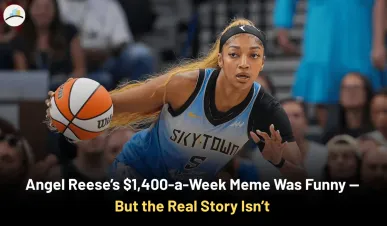
A Meme That Hit Too Close to the Truth
What started off as a joke turned into a conversation the WNBA couldn’t avoid. A meme joking that Angel Reese makes just $1,400 a week went viral, and for a second, it felt like just another Twitter moment. But then people looked closer—and found it wasn’t far from the truth. Reese, one of the league’s biggest breakout stars, is actually earning around $74,000 a year with the Chicago Sky. That breaks down to roughly $1,440 a week.
That meme wasn’t an exaggeration. It was a mirror. And it’s forced the league, its fans, and its critics to think harder about what WNBA players are really up against.
Notice how you don't see any actual video of Angel Reese saying "Y'all make $1400 a week, I make $1400 in 7 days."
— K E V I N ⭑⭒⭒⭒⭒ (@KevChestnut) July 29, 2025
It's almost like it was completely made up... https://t.co/MmGEeUEVsa
The Real Problem Isn’t the Salary—It’s the Math That Comes With It
Angel Reese has been upfront. She’s not just playing for pride or headlines. She’s playing in a city where her rent alone hits $8,000 a month. That’s more than her WNBA salary covers. Without endorsement deals and NIL earnings, she wouldn’t be able to stay afloat in the same market she represents on court.
And she’s not alone. A lot of rookies and even seasoned players are in the same boat—especially those without major sponsorship deals or off-court revenue streams. It’s not just about low pay. It’s about how disconnected that pay is from what it costs to be a professional athlete in major American cities.
This is the stuff we don’t talk about enough. Athletes with national-level visibility still needing side gigs or brand deals to make rent.
More Articles:
Why This Moment Feels Bigger Than a Joke
Here’s what matters: Angel Reese didn’t create that meme, but she leaned into it. And that gave it power. It’s not just about her salary—it’s about every woman in the WNBA carrying the weight of a growing league with shrinking returns. This moment is bigger than one tweet. It’s about where women’s basketball goes next.
She’s not threatening a strike out of nowhere. She’s asking: “Why do we still have to fight this hard?” That’s a fair question.
Let’s not forget, WNBA viewership is up. Sponsorships are growing. Expansion is underway. So why haven’t salaries kept pace?
Business Implications That Could Shake the League
Right now, players only get a small slice of the league’s revenue. Less than 10%. Compare that to the NBA, where players receive around 50% of shared income. The CBA (collective bargaining agreement) for the WNBA is up for renegotiation in 2025, and players like Reese are already signaling they won’t stay quiet during those talks.
If salaries don’t increase—or at least the revenue share isn’t rebalanced—the WNBA could risk a talent drain. Or worse, the rise of new, player-led leagues like Unrivaled could start pulling stars away from the main court. If that happens, advertisers and TV networks will have decisions to make.
The risk here isn’t just losing players. It’s losing control of the narrative.
What People Aren’t Paying Enough Attention To
There’s a layer here that doesn’t get discussed often: how much of the league’s momentum is now carried by players’ personal brands. Reese, Caitlin Clark, and others bring millions of followers, sponsorship power, and media attention. Their value doesn’t just come from their on-court performance—it comes from what they represent. Culture, attention, identity.
That makes their public statements more powerful. When Angel Reese talks about money, she’s not just speaking as a player. She’s speaking as one of the WNBA’s most bankable assets.
So if players with that kind of platform are saying the pay system doesn’t work—it probably doesn’t.
The Bigger Picture Moving Forward
This whole moment started with a meme. But it’s turned into something more than internet content. It’s put a spotlight on an old problem in a new way. And if the WNBA leadership doesn’t take it seriously, they’re going to miss the wave they helped create.
Because players like Angel Reese? They’re not going to stay silent. And the next generation coming in won’t either. The league has a chance to change this—not just to fix pay, but to reshape what professional women’s basketball can look like when it's treated like a business, not a charity.
That’s the real story here. And it's just getting started.



