
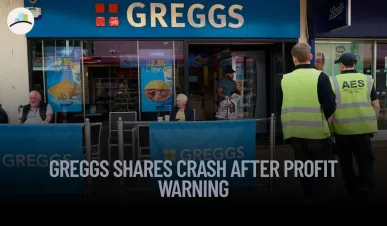
Greggs, the UK’s iconic high-street bakery chain, reported a 14% decline in pretax profit for the first half of 2025, coming in at £63.5 million compared to £74.1 million during the same period in 2024. This marks one of its steepest year-on-year drops since the COVID-19 pandemic. While total group revenue grew approximately 7% to reach £1.03 billion, the modest like-for-like sales increase of 2.6% in company-managed stores underwhelmed investors, given the chain’s aggressive expansion and evolving product strategy.
The company attributed much of the revenue disappointment to the extreme summer heat experienced across the UK in June, which led to a significant drop in foot traffic and decreased demand for its traditionally hot product range.
More Articles:
Shares at Lowest Since the Pandemic
Greggs' stock has experienced a brutal correction in 2025, with shares falling more than 40% year-to-date. This recent earnings report only deepened market concerns. The share price has now returned to levels last seen during the early days of the pandemic in 2020. Analysts note that the share price reflects not only cyclical factors like weather, but also a growing unease over the long-term scalability and profitability of Greggs’ growth strategy.
Investors are beginning to question whether the company has the capacity to sustain its rapid expansion amid fluctuating demand and rising input costs. The market reaction highlights concerns that Greggs may be attempting to scale too quickly in an increasingly unpredictable consumer environment.
Heatwave Dampens Core Sales as Cold Offerings Fall Short
The UK experienced its hottest June on record, significantly impacting in-store footfall and suppressing sales of Greggs’ most popular hot items, including sausage rolls, pasties, and baked sandwiches. Though Greggs tried to offset this with a greater emphasis on cold beverages and lighter options, these categories failed to deliver sufficient volume or margins to balance the shortfall.
The result underscores Greggs’ continued exposure to weather volatility and its reliance on in-store, temperature-sensitive products. Despite enhancements to its summer menu and cold drink offerings, the lack of air-conditioned seating and the company’s hot-food DNA limited its ability to capture sales in extreme weather conditions.
Aggressive Expansion Strategy: A Risky Bet?
Despite the earnings setback, Greggs remains committed to its ambitious expansion plans. The company aims to open between 140 and 150 net new outlets in 2025, bringing its total footprint closer to the 3,000-store milestone. As of mid-2025, Greggs operates 2,649 locations across the UK.
The management's long-term vision involves saturating high-traffic, convenience-driven locations including retail parks, transport hubs, and forecourts. However, analysts have raised serious concerns about cannibalisation. Internal geographic mapping shows that roughly 20% of Greggs locations are situated within 500 meters of another outlet. As expansion continues, the risk of diminishing returns per location could increase, especially if footfall remains stagnant and operational costs continue to rise.
While Greggs has historically used expansion as a hedge against stagnating sales growth, the current macroeconomic and competitive landscape may not support such an aggressive rollout without consequence.
Inflation and Operational Investment Squeeze Margins
Another key pressure point for Greggs is the combined weight of cost inflation and increased capital expenditure. Ingredients and packaging inflation remains stubbornly high at approximately 6%, while wage inflation, national insurance hikes, and energy costs are contributing to an uptick in overall operating expenses.
Additionally, Greggs is heavily investing in two major logistics and manufacturing hubs in Derby and Kettering. While these facilities are designed to improve long-term supply chain efficiency and capacity, the short-term effect has been margin erosion. The company anticipates a 40-basis-point drag on operating margins through 2026 and 2027 as a result of these upfront investments.
Analysts are split on whether these expenditures represent prudent long-term planning or mistimed capital allocation in the face of unpredictable revenue dynamics.
Strategic Pivot: Diversification Into Delivery and Retail Channels
Greggs is working to diversify its revenue streams beyond traditional in-store purchases. Key strategies include strengthening its digital order infrastructure, deepening partnerships with delivery platforms like Just Eat and Uber Eats, and investing in the Greggs app ecosystem.
Digital and delivery orders now account for an increasingly significant share of evening and late-night trade, with evening sales representing nearly 9% of shop revenues. Greggs has also launched a range of frozen, “bake-at-home” products through partnerships with Tesco and Iceland, aiming to capture a portion of the at-home meal occasion market.
While these moves signal strategic foresight, their current contribution to profitability remains marginal. Execution risk is high, particularly as Greggs ventures into segments dominated by legacy supermarket chains and well-established QSR (quick service restaurant) competitors.
Greggs' shares fell to the lowest since 2020 after the UK bakery chain reported a drop in profit in the first half of the year https://t.co/FdPazHASIN
— Bloomberg (@business) July 29, 2025
Procapitas Insights: What Markets May Be Missing
1. Weather-Driven Volatility Is Becoming Structural:
Greggs has repeatedly cited weather events—snowstorms, heatwaves, floods—as key disruptors to footfall. While previously viewed as short-term anomalies, these patterns are now recurring enough to merit reclassification as structural risks. The company’s business model may need rethinking in terms of product diversification and store environment adaptation (e.g., climate-controlled seating, seasonal menus).
2. Menu Complexity Could Undermine Brand Identity:
From traditional sausage rolls to new burritos, pizza slices, and pasta pots, Greggs is increasing menu variety to expand daypart appeal. But as menu complexity grows, so does operational inefficiency. More critically, there’s a risk of eroding the simple, value-driven brand identity that made Greggs a household name.
3. Expansion May Create More Headwinds Than Tailwinds:
While store count is increasing, net productivity per store appears to be flattening. Overlapping catchment areas and saturation of suburban markets mean newer locations may not significantly add to total revenue. Expansion could eventually cannibalize existing stores unless customer demand rises in tandem.
4. Workforce Pressures Are Mounting Internally:
Employee forums and anecdotal evidence suggest that staff are stretched thin in many locations. As the company opens more stores without proportionate increases in backend and HR infrastructure, quality of service, customer satisfaction, and brand loyalty could all be impacted.
5. Timing Mismatch Between Investment and ROI:
Large infrastructure investments like Derby and Kettering may not yield returns for another 12–24 months, even as they begin weighing on financial performance today. Investors expecting near-term payback may be disappointed, particularly if sales growth remains modest.
Disclaimer:
This article is intended for informational purposes only and does not constitute investment advice. Procapitas does not provide personalized financial recommendations. Always consult a licensed financial advisor before making investment decisions. Information is based on publicly available sources as of June 2025 and Procapitas’ independent research and analysis.



