
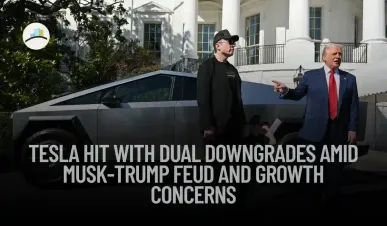
Tesla Inc. is facing heightened scrutiny from Wall Street after two prominent investment firms downgraded the EV giant’s stock, citing concerns around slowing growth and the impact of CEO Elon Musk’s public feud with former U.S. President Donald Trump. The downgrades come at a critical juncture as Tesla navigates economic headwinds, intensifying EV competition, and waning investor confidence.
On Monday, both HSBC and Morgan Stanley issued lower ratings on Tesla stock, pointing to stalled growth momentum, operational uncertainty, and increased public distractions linked to Musk’s controversial leadership. Shares of Tesla dropped in early trading following the news.
The Musk-Trump Fallout: A Political Distraction?
The public feud between Elon Musk and Donald Trump has made headlines in recent weeks. What began as conflicting views on political endorsements has escalated into a series of combative exchanges on social media and in public forums. While Tesla has historically operated on the edge of controversy, analysts say the political spectacle is now beginning to impact investor sentiment.
Musk, known for his active presence on X (formerly Twitter), has criticized Trump’s trade policies and reportedly declined to meet with the former president during a high-profile Republican donor event. Trump, in turn, called Musk "overrated" and questioned Tesla’s reliance on federal subsidies. This ongoing rift has led some investors to view Musk’s involvement in political discourse as an unnecessary distraction from Tesla’s operational focus.
Also Read:
Robotaxi Strategy Faces Skepticism
In addition to the political headlines, Tesla's long-touted robotaxi business model is coming under renewed scrutiny. HSBC analysts expressed doubt over the near-term viability of Tesla’s autonomous vehicle ambitions, stating that the timeline for full autonomy remains unclear and the competitive landscape is rapidly evolving.
Tesla had planned to unveil a dedicated robotaxi in 2024, but recent delays and regulatory hurdles have pushed expectations further out. Morgan Stanley analysts wrote that while the concept of robotaxis holds long-term promise, Tesla is yet to demonstrate consistent progress in key areas like AI reliability and safety certifications.
Industry experts also note that competitors such as Waymo (owned by Alphabet), Cruise (owned by GM), and Baidu in China are already running limited public trials of autonomous taxis, challenging Tesla's first-mover narrative.
EV Competition Heats Up
Tesla is no longer the undisputed leader in the electric vehicle race. Traditional automakers like Ford, Volkswagen, and Hyundai are scaling up their EV production lines, while Chinese companies like BYD continue to dominate the global EV market.
BYD, for instance, surpassed Tesla in quarterly EV deliveries earlier this year, signaling a shifting global dynamic. Meanwhile, European and U.S. regulators are investigating Tesla’s marketing claims about Full Self-Driving (FSD) capabilities, further denting its credibility.
Analysts also highlight that Tesla’s once enviable profit margins are narrowing due to price wars in key markets like China and Europe. The company has slashed prices multiple times in 2024 and 2025 to maintain sales momentum, a move that has weighed on margins.
Financial and Market Indicators
Tesla’s recent earnings showed a year-over-year decline in net income, attributed to rising costs and flat delivery numbers. Free cash flow also dipped, prompting concerns about capital efficiency as the company pushes forward with massive AI and robotics investments.
Institutional investors are increasingly questioning whether Tesla's core auto business can sustain its lofty valuation. As of June, Tesla trades at more than 50 times forward earnings, significantly higher than peers like GM and Ford.
Analyst Downgrades: What They’re Saying
Morgan Stanley downgraded Tesla from “Overweight” to “Equal-weight,” citing a “clouded near-term outlook” and urging caution until the company shows clear reacceleration. HSBC issued a similar warning, pointing to “risk factors beyond fundamentals,” including Musk’s public behavior and its spillover effects on Tesla’s brand.
“Tesla remains a transformative company, but near-term volatility and uncertainty around leadership focus are limiting catalysts for upside,” said HSBC’s head of automotive research.
Broader Implications and What’s Next
The dual downgrades underscore the increasing pressure on Tesla to prove that its multi-pronged strategy—from AI and robotics to EVs and energy—is sustainable and not overly dependent on Musk’s personal brand.
Looking ahead, investors will closely watch Tesla’s Q2 earnings in July for signs of operational improvement. Key metrics to monitor include vehicle deliveries, energy segment performance, progress on robotaxi development, and updates on international expansion—especially in India and Southeast Asia.
The company is also expected to host its long-delayed “AI Day” event in August, which may provide further clarity on its autonomous driving roadmap and Dojo supercomputer initiative.
Whether Tesla can regain investor trust and operational focus amid political noise remains a pivotal question for the second half of 2025.
Source
Source: Bloomberg – Tesla Hit with a Pair of Downgrades Amid Fallout from Trump Feud



