
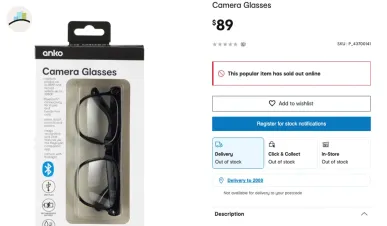
The Anko glasses can capture 8MP photos and 1080p video while playing music, handling calls and accessing AI features, but their sudden popularity has reignited concerns about people being filmed without their knowledge.
Kmart’s new $89 camera glasses have reportedly sold out across Australia, turning an affordable piece of wearable technology into one of the country’s most controversial new products.
The clear-lens, black-framed glasses look similar to regular eyewear but contain a built-in camera capable of taking photographs and recording high-definition video. They can also play music, answer calls and connect to an AI-powered companion app. According to reports, the product was unavailable across Kmart stores and online as of Monday, although availability may change as stock is updated.
Their low price has helped generate enormous interest. However, digital-rights advocates warn that making discreet camera glasses available for less than $100 could dramatically increase the number of people recording strangers in public without clear consent.
Why Kmart’s $89 Camera Glasses Are Suddenly Everywhere
Kmart sells the Anko-branded camera glasses for A$89, placing them far below the price of Ray-Ban Meta smart glasses, which start at approximately A$337 in Australia.
That price gap is central to the product’s sudden success. Camera-equipped eyewear is no longer restricted to technology enthusiasts willing to spend several hundred dollars. Kmart has brought the concept into the mainstream retail market at a price comparable to basic wireless earbuds or an entry-level smartwatch.
The Guardian reported that the glasses had sold out in stores across Australia and online as of Monday. The strong demand suggests that many shoppers are attracted by the opportunity to record hands-free videos without paying the premium attached to Meta-branded eyewear.
However, the same affordability that makes the glasses attractive to consumers is what concerns privacy campaigners. A technology previously used by a relatively small number of people could now become common in shopping centres, public transport, schools, workplaces, beaches and other shared spaces.
What Can the Kmart Anko Camera Glasses Do?
Kmart’s product listing describes the glasses as a hands-free way to capture photographs and videos while remaining connected on the move.
The Anko glasses can take photographs at resolutions of up to 8 megapixels and record video at up to 1080p. They connect to a smartphone through Bluetooth and include speakers and a microphone for music playback and hands-free phone calls.
Users can control the glasses through physical buttons and touch controls. Image-recognition and chat functions are available through the HeyCyan companion app, which can be downloaded on a connected smartphone.
Kmart lists an approximate working time of 3.5 hours when the glasses are used at 80% volume. Charging takes around two hours, while the device has an IPX4 water-resistance rating, meaning it is intended to resist light splashes rather than full immersion.
Kmart Anko camera glasses specifications
| Feature | Kmart Anko Camera Glasses |
|---|---|
| Price | A$89 |
| Photo resolution | Up to 8MP |
| Video resolution | Up to 1080p |
| Connectivity | Bluetooth |
| Audio features | Music and hands-free calls |
| AI functions | Image recognition and chat through HeyCyan |
| Battery life | Approximately 3.5 hours at 80% volume |
| Charging time | Approximately two hours |
| Water resistance | IPX4 |
The product manual states that the AI service may be available for six months after the app is activated. Continued access could later involve a charge, while basic functions would remain available. It also instructs users to follow local laws and respect other people’s privacy when using the camera, video or voice-assistant features.
Are the Kmart Camera Glasses the Same as Meta Glasses?
No. The Anko camera glasses are not manufactured or operated by Meta.
They have attracted comparisons because their thick black frames and built-in camera resemble Ray-Ban Meta glasses. Both products can capture photographs and video, play audio and manage phone calls without requiring the wearer to hold a smartphone.
However, the Kmart product runs through the HeyCyan platform rather than Meta’s software and AI ecosystem. Its official feature list is also more limited than the functionality promoted for Meta’s premium glasses.
Meta says millions of people use its AI glasses for photography, video, music and assistant features. It has also developed privacy safeguards after criticism surrounding the possibility of discreet recording.
Meta says its glasses display a white capture LED when photographs or videos are being recorded. The company also says the camera is disabled when the system detects that the light has been blocked, physically altered or destroyed.
Kmart’s online listing highlights the Anko model’s camera, flashlight, Bluetooth and AI functions. Its manual places responsibility on the user to comply with local recording laws and respect the privacy of others.
Why Are Privacy Experts Alarmed?
The major concern is not simply that the glasses contain a camera. Smartphones, action cameras and security systems already record enormous amounts of video every day.
The difference is that camera glasses point wherever their wearer is looking and can resemble ordinary eyewear. A person standing nearby may not immediately realise that the glasses contain a recording device or that a photograph or video is being captured.
Tom Sulston, head of policy at Digital Rights Watch, described camera-equipped smart glasses as a privacy nightmare and argued that Australian privacy legislation had not kept pace with changes in wearable technology.
Critics are particularly concerned about their use in locations where people may reasonably expect greater sensitivity, including beaches, gyms, medical facilities, changing areas, schools and public toilets.
The technology could also be misused to record confrontations, harass strangers or create social-media content without properly informing the people appearing in it. Privacy advocates fear that cheaper products will make such behaviour more frequent because the financial barrier to owning camera glasses has fallen sharply.
Can Someone Legally Record You With Camera Glasses in Australia?
The answer depends on where the recording occurs, who is doing it and how the resulting footage is used.
The Office of the Australian Information Commissioner says photographs and videos can be treated as personal information when the person shown can be identified. However, the federal Privacy Act generally does not apply when an individual takes a photograph or video in a purely personal capacity.
That does not mean people have unlimited permission to record anywhere they choose.
State and territory surveillance laws, criminal laws, workplace rules, venue policies and laws covering private or intimate activities may still apply. A business or organisation collecting identifiable images may also have obligations under the Privacy Act and Australian Privacy Principles.
The OAIC advises people concerned about being recorded to consider whether relevant Commonwealth, state or territory laws apply to their situation. The regulator has also said it is monitoring community concerns surrounding the rollout of camera-equipped wearable technology.
The legality of an individual recording should therefore be assessed based on the specific circumstances. The fact that a place is accessible to the public does not automatically make every type of recording or subsequent publication acceptable.
What Has Kmart Said About the Controversy?
Kmart has defended the product as part of a growing international wearable-technology category.
A company spokesperson said similar products were already available from major technology and eyewear brands around the world. Kmart said it expected customers to use the glasses responsibly, respectfully and in accordance with applicable laws and community expectations concerning privacy.
The product’s instruction manual contains a similar warning. It tells users to respect other people’s privacy and comply with local laws when operating the camera, video or voice-assistant functions.
That warning places much of the responsibility on the wearer. It does not eliminate concerns about how bystanders can recognise that recording is occurring or object before footage has already been captured.
Are Kmart’s Camera Glasses Still Available?
The Guardian reported that the Anko glasses were sold out across Australian Kmart stores and online as of Monday.
Kmart’s website continues to display the product page and its A$89 price, but actual availability can vary according to location, postcode and stock updates. The company had not publicly announced a national restock date in the available reporting.
The sellout does not necessarily mean every unit has already reached a customer. Some products may still be awaiting collection, delivery or cancellation, while new stock could become available without a major announcement.
Consumers should rely on Kmart’s official stock checker rather than third-party resale listings. Strong demand can lead to inflated resale prices or misleading advertisements, particularly when a low-cost product becomes viral on social media.
What Information Does the HeyCyan App Handle?
The glasses rely on the HeyCyan companion app for image-recognition, chat and media-transfer functions.
Kmart’s product page confirms that photographs and videos can be transferred from the glasses through the software. The manual also states that AI functions may become chargeable after an initial six-month period.
Before activating the product, users should read the app’s current privacy policy and permissions carefully. Particular attention should be paid to whether media is processed locally or through remote servers, how long uploaded information is retained and whether it may be used to improve AI services.
Those questions matter because the privacy debate involves two groups. The first is the wearer whose account, voice commands and media may pass through an app. The second is every bystander who could appear in the images or audio without directly interacting with the product.
MORE ARTICLES:
Could the Glasses Have Legitimate Benefits?
Camera glasses are not inherently designed only for covert recording.
They can help travellers document experiences while keeping their hands free, allow cyclists or walkers to capture a first-person view and give content creators an alternative to holding a phone.
Voice assistants and image-recognition tools may also offer accessibility benefits. A camera connected to an AI system could help some users identify objects, read signs or receive spoken information about their surroundings.
The problem is that useful functions and privacy risks exist inside the same device. A product can support accessibility and convenient photography while still being misused to record people who have not agreed to appear.
The debate is therefore not simply about banning new technology. It is about whether clear recording indicators, strong app protections, responsible-use rules and modern legislation can develop quickly enough to keep pace with increasingly discreet cameras.
Why This $89 Sellout Matters Beyond Kmart
Kmart’s camera glasses represent a significant moment because they move wearable recording technology out of the premium category.
At A$89, the product costs roughly a quarter of the starting price reported for Ray-Ban Meta glasses. That makes it far more accessible to teenagers, casual buyers, social-media creators and shoppers who may never have considered purchasing camera-equipped eyewear before.
The sellout shows that consumer interest is already strong. It also suggests that other discount retailers and online marketplaces may expand their own low-cost smart-glasses ranges.
As these devices become easier to buy, the social question may change from whether someone nearby is wearing a camera to how people can reliably tell when that camera is operating.
Kmart has succeeded in making camera glasses affordable. The more difficult challenge for retailers, technology companies and lawmakers is ensuring that affordability does not come at the expense of everyone else’s privacy.



