
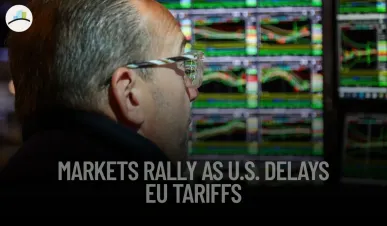
Global financial markets received a major boost as U.S. equity futures posted strong gains following renewed optimism surrounding trade negotiations between the United States and the European Union. The positive momentum comes after U.S. President Donald Trump announced a delay in imposing a planned 50% tariff on European imports, a move that soothed investor concerns and signaled a potential thaw in transatlantic trade tensions.
Despite U.S. markets being closed for Memorial Day, futures trading reflected growing confidence among investors. Futures tied to the Dow Jones Industrial Average rose over 1.2%, while those on the S&P 500 and Nasdaq-100 climbed by 1.1% and 1.3%, respectively. Analysts attribute this upward trend to President Trump’s decision to postpone the tariff hike, which was initially scheduled for June 1, now deferred until July 9, providing a critical window for further diplomatic engagement.
A Reprieve from Trade Uncertainty
The announcement followed a high-level conversation between President Trump and European Commission President Ursula von der Leyen, with both sides reportedly agreeing to intensify efforts to reach a mutually beneficial trade agreement. The unexpected pause in tariff implementation triggered a ripple effect across European markets, with major indices like the Stoxx Europe 600, Germany’s DAX, and France’s CAC 40 rebounding from last week’s losses.
European shares rallied, driven by gains in industrials, financials, and technology sectors—areas most sensitive to geopolitical developments and trade policies. This shift also reinforced positive investor sentiment in other global markets, including Asia, where markets in Tokyo and Hong Kong ended the day in the green.
Currency and Bond Markets React
In the currency markets, the euro appreciated modestly against the U.S. dollar, indicating investor belief in the resilience of the eurozone economy should trade disputes de-escalate. Additionally, the 10-year German bund yield edged higher, reflecting decreased demand for safe-haven assets as risk appetite returned.
Meanwhile, bond traders in the U.S. remain cautious, awaiting clarity on inflation data due later in the week. With Treasury markets closed for the holiday, much of the reaction was speculative, hinging on future data releases and central bank cues.
Cautious Optimism Ahead of Key Economic Events
While the short-term response from investors has been overwhelmingly positive, financial analysts urge caution. Markets are highly sensitive to geopolitical developments, and the delayed tariffs may still go into effect if negotiations stall. Furthermore, looming inflation concerns and upcoming economic data, including jobless claims and consumer spending figures, will likely play a pivotal role in shaping future market direction.
“Today’s rally is driven more by relief than resolution,” said Lisa O’Connell, a senior strategist at Capital Axis Partners. “We’re in a wait-and-see phase. If talks progress well, markets could maintain this momentum. But if rhetoric turns aggressive again, we could see a reversal just as quickly.”
Broader Market Context and Investor Strategy
This development also comes amid a broader reassessment of global monetary policy. With inflation showing signs of stabilizing, investors are increasingly betting on potential rate cuts by the Federal Reserve in the latter half of the year. Combined with easing trade anxieties, this has led to increased risk-taking across asset classes.
Investors are now focusing on sectors that stand to benefit from easing tariffs and improved trade flows, including manufacturing, automotive, and semiconductors. Technology stocks, in particular, have been at the forefront of the recovery, supported by robust earnings and global demand.
Disclaimer:
The information provided in this article is for general informational purposes only. Procapitas does not offer investment advice or endorse any specific financial instruments or strategies. Readers are encouraged to conduct their own research or consult with a licensed financial advisor before making investment decisions.
Source:
More Articles:



