
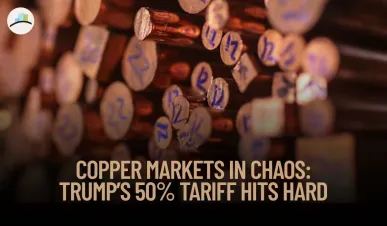
In a move that has shaken global commodity markets, former U.S. President Donald Trump announced a proposal to impose a 50% import tariff on copper under the controversial Section 232 trade mechanism. Framed as a national security imperative to revitalize America’s domestic mining capacity, the policy shocked investors and sparked an immediate divergence between U.S. and international copper prices.
While COMEX copper futures in the U.S. surged by 12–13%, reaching record highs above $5.85 per pound, London Metal Exchange (LME) copper futures dropped by 2.4%, closing near $9,590 per metric tonne. The news has triggered a scramble in the global physical copper trade and opened up a significant arbitrage gap between U.S. and international prices.
More Articles:
London Prices Fall as U.S. Creates Historic Arbitrage Gap
The policy’s immediate impact has been a redirection of global copper flows toward the United States. Large-scale commodity traders and logistics firms began front-loading copper shipments into U.S. ports in anticipation of the tariff, depleting inventories in Asia and Europe and paradoxically depressing non-U.S. copper prices.
This redirection created a record-setting arbitrage spread between COMEX (U.S.) and LME (global) copper prices, surpassing $900 per metric tonne. The wide gap is unsustainable long-term, but it reflects a short-term pricing distortion that many analysts believe could persist for several months depending on how quickly the policy is formalized and enforced.
This pricing imbalance underscores a broader issue in commodity markets: how geopolitically driven trade policies can supersede fundamental supply-demand dynamics in the short run.
Global Supply Chains Under Pressure as U.S. Mines Can't Meet Demand
The proposed tariff raises significant concerns about the viability of reshoring the copper supply chain. Currently, domestic copper production in the U.S. fulfills only about 55% of national demand. The remaining 45% is met through imports—primarily from Chile, Peru, Mexico, and Canada.
Analysts warn that U.S. mining infrastructure lacks the capacity to meet sudden demand increases, especially given regulatory bottlenecks, long lead times, and local opposition to new mining projects. Even active projects like Rio Tinto’s Resolution Copper and BHP’s investments in Arizona are years away from full-scale production.
In effect, this tariff will likely increase costs for manufacturers and end-users in sectors such as automobiles, electronics, energy infrastructure, and defense. It’s estimated that the average cost of an electric vehicle could rise by $300 to $400 due to higher copper costs alone, not including the downstream inflationary pressures on wire, cabling, and other infrastructure inputs.
U.S. Miners Stand to Gain While Global Traders Brace for Impact
While global consumers and manufacturers may suffer, some domestic players are poised to benefit. Major copper producers like Freeport-McMoRan, Southern Copper Corporation, and Rio Tinto’s U.S. operations may see significant margin expansions. U.S. scrap processors may also gain from higher local pricing and demand for recycled copper.
However, the broader trade ecosystem is bracing for volatility. Global trading houses like Glencore, Trafigura, and Mitsubishi Corp. have already begun re-routing shipping volumes, raising concerns about inventory shortages in Asian and European markets later in Q3 and Q4 of 2025.
Moreover, the move is likely to strain diplomatic relations with key allies. Copper-exporting nations such as Chile and Peru could face export challenges unless they are exempted from the tariffs. Canada and Mexico, under USMCA rules, are expected to push for carve-outs, potentially complicating trade negotiations already made fragile by election-year rhetoric.
🌎 #Copper Market in Turmoil as Trump Touts 50% Tariff on US Imports - Bloomberghttps://t.co/62gwr8H7vZ pic.twitter.com/39VaYgmU8O
— Christophe Barraud🛢🐳 (@C_Barraud) July 9, 2025
Strategic Play or Political Theater? Analysts Weigh In
Many market watchers see the 50% tariff figure as a political gambit—a high anchor designed to be negotiated downward. Trade experts anticipate the final tariff may land closer to 25%, particularly if key trading partners are granted partial or full exemptions.
Some suggest the policy is not purely economic, but aimed at appealing to the political base that supports economic nationalism and industrial self-reliance. This signals a broader return to protectionist trade policies in the lead-up to the 2025 presidential elections.
Still, uncertainty around implementation timelines, exemption criteria, and the longevity of such policies has left commodity markets on edge. Businesses that rely on long-term copper contracts are in wait-and-see mode, hesitant to enter new agreements in an unstable pricing environment.
Disclaimer:
This article is intended for informational purposes only and does not constitute investment advice. Procapitas does not provide personalized financial recommendations. Always consult a licensed financial advisor before making investment decisions. Information is based on publicly available sources as of June 2025 and Procapitas’ independent research and analysis.



