
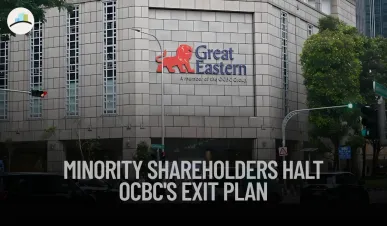
Great Eastern Holdings Ltd., one of Singapore’s most established insurance groups, is set to resume trading after a significant shareholder decision blocked Oversea-Chinese Banking Corporation’s (OCBC) latest attempt to delist the company. OCBC, which owns over 93% of Great Eastern, needed 75% approval from minority shareholders to proceed with the privatization effort. However, it only secured 63.49%, falling short and effectively halting the deal.
This outcome sends a strong signal to Singapore’s corporate landscape: minority shareholders are no longer passive stakeholders and can shape high-stakes transactions. The decision also marks a rare public setback for OCBC, which had been pursuing full ownership of Great Eastern for more than two decades.
More Articles:
The Strategy Behind the Delisting Attempt
OCBC offered S$30.15 per share in its latest offer, representing a 17.8% premium over the previous bid in May 2024. This premium, though substantial, failed to sway minority investors who believed the valuation did not fully capture Great Eastern’s long-term earnings potential, brand value, and insurance footprint across Southeast Asia.
Notably, the free float of Great Eastern’s shares had dipped below 10% after OCBC’s prior share accumulation, prompting the Singapore Exchange to suspend trading in July 2024. OCBC’s intention was clear: consolidate the company, streamline operations, and potentially restructure Great Eastern under a fully owned umbrella. However, the refusal of minority holders has now forced OCBC to abandon this strategy.
Implications of Trading Resumption
With the delisting bid rejected, Great Eastern will now resume trading on the Singapore Exchange. This move restores liquidity for remaining minority shareholders and allows for renewed market-based price discovery.
However, the path forward is not without challenges. Investors will closely monitor the stock’s price behavior, especially since there is now limited public float. This could lead to volatility or artificially constrained price movements due to low liquidity. Analysts also warn that institutional investors may hesitate to reenter unless OCBC outlines a clear plan to restore free float above regulatory thresholds.
Minority Shareholders Flex Growing Influence
The rejection of the deal is a powerful example of how shareholder activism is maturing in Singapore. Despite support from an independent financial adviser who deemed the offer "fair and reasonable," many investors—including prominent families and value-focused funds—felt the bid undervalued Great Eastern’s strategic assets.
This vote suggests a broader trend: minority investors are more willing to challenge corporate moves they view as undervaluing their stakes, especially when controlling shareholders already exert substantial influence. It also reinforces the importance of corporate transparency and stakeholder alignment in markets with concentrated ownership structures.
What OCBC Might Do Next
OCBC has officially stated it will not make another offer. This puts the bank in a unique position. It must now decide how to manage its dominant stake while complying with public listing requirements. Several possibilities include:
-
Issuing non-voting shares to raise free float levels
-
Introducing a share buyback program to balance liquidity
-
Undertaking partial asset spinoffs to create new listings
-
Repositioning Great Eastern within OCBC’s broader capital management plan
For now, OCBC appears content to maintain its current stake without additional consolidation efforts. However, investor expectations for better governance and transparency will only grow in the wake of this failed bid.
Great Eastern set to resume trading after delisting vote fails; Chuan Grove site draws 7 bids with S$1,376 psf ppr top bid from Sing Holdings, Sunway joint venturehttps://t.co/7u2wmnrEcI pic.twitter.com/fvQL85xebX
— The Business Times (@BusinessTimes) July 8, 2025
Strategic Takeaways for Investors and the Market
-
Minority shareholder influence is rising
This case could serve as a benchmark for future transactions in Asia where controlling shareholders hold over 90% stakes. Investors now expect meaningful participation in decisions. -
Free float and liquidity matter
Companies with very low free float face both market skepticism and regulatory attention. Restoring adequate liquidity may become a strategic priority. -
Valuation discipline will be demanded
Premiums alone may not be enough to justify privatizations unless supported by growth narratives, synergies, or operational transformation. -
Governance frameworks are evolving
Singapore’s reputation for robust capital markets may be strengthened if this case leads to tighter rules on delisting thresholds and better shareholder protections. -
Delisting attempts are no longer assured
Even with large stakes, buyers must now account for reputational risk, minority resistance, and governance scrutiny—especially in high-profile public companies.
Disclaimer:
This article is intended for informational purposes only and does not constitute investment advice. Procapitas does not provide personalized financial recommendations. Always consult a licensed financial advisor before making investment decisions. Information is based on publicly available sources as of June 2025 and Procapitas’ independent research and analysis.



