
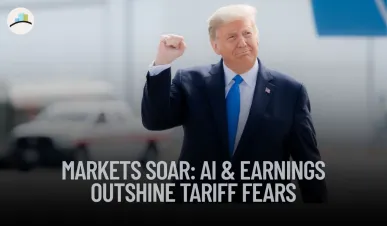
U.S. stock indices defied geopolitical concerns and surged to new highs, with the S&P 500 closing above 6,280. Investor confidence remained robust, fueled by stronger-than-expected earnings, particularly from travel and industrial sectors, and continued optimism around artificial intelligence stocks.
Contrary to traditional market behavior, escalating trade tensions had minimal negative impact on equities. Despite the Trump administration’s announcement of 50% tariffs on select Brazilian exports and key commodities like copper, equity benchmarks not only stabilized but advanced.
This suggests a significant shift in investor psychology. While tariffs typically introduce inflationary risk and disrupt global supply chains, investors seem to interpret the new policy moves as politically driven rather than economically destabilizing. Some even see them as positioning for upcoming trade negotiations, rather than a precursor to a full-blown trade war.
More Articles:
AI Stocks Continue Dominating Market Leadership
Among the biggest drivers of Thursday’s rally were the mega-cap technology companies, particularly those involved in artificial intelligence. Nvidia, now surpassing a $4 trillion market capitalization, continued its rally, gaining close to 0.8% and reinforcing its position as the undisputed leader in the AI hardware space.
Microsoft also made headlines, trading above the $500 mark as enterprise AI adoption remains on an accelerated curve. Investors are treating these names as the modern-day utilities of the digital economy, with AI demand perceived as nearly inelastic, even amid broader macroeconomic headwinds.
While valuations are undeniably high, the market is pricing in not just current dominance but also future ecosystem control. From infrastructure to inference, companies like Nvidia and Microsoft are central to the AI stack.
Yet, beneath the surface, concerns around saturation, government regulation, and technological disruption persist. Investors with exposure to these stocks should consider balancing their positions with high-quality, reasonably priced growth or industrial names.
Corporate Earnings Inject Fresh Momentum
The earnings season has begun on a strong note, adding fundamental support to the market's upward trend. Delta Air Lines reported second-quarter earnings that exceeded expectations on nearly every metric, including load factor, revenue per seat mile, and operational efficiency. The company reinstated full-year guidance, which had been withdrawn earlier due to fuel price volatility and geopolitical uncertainty.
Delta’s stock surged over 12% following the release, boosting airline peers and contributing to the day’s broad rally. The travel industry appears to be benefiting from resilient consumer demand, particularly in domestic and short-haul international segments.
Separately, WK Kellogg, a legacy food brand spun out of Kellanova, saw its stock climb over 30% amid reports of a potential acquisition by Italian confectionery giant Ferrero. While the deal remains speculative, investor enthusiasm underscores the market’s hunger for consolidation plays in defensive sectors, especially as input costs stabilize and consumer staples regain pricing power.
These two examples reflect a deeper market theme: performance is being rewarded, and catalysts—whether earnings or M&A—are fueling both volume and volatility.
Materials and Defense Sectors Reemerge as Winners
The tariff news, though shrugged off by tech and consumer sectors, ignited gains in the materials and defense-linked industrial space. MP Materials, a key player in rare earth element mining, jumped more than 50% on news that it had secured a long-term contract with the U.S. Department of Defense to supply domestically sourced magnets for military applications.
This move is significant for multiple reasons. First, it underscores Washington’s strategic shift away from Chinese-dominated supply chains for critical minerals. Second, it signals that federal spending is increasingly focused on industrial self-reliance, creating multi-year tailwinds for companies aligned with national security priorities.
Investors seeking long-term exposure to geopolitical themes should closely watch this sector. Stocks like MP Materials are no longer niche plays but increasingly core holdings for funds focused on defense, reshoring, and strategic autonomy.
Cryptocurrency Finds Its Footing Amid Broader Risk-On Mood
Another notable development was Bitcoin’s rise to new 2025 highs, trading above $113,000. Despite tighter regulation and IRS scrutiny on crypto flows, demand from institutional investors continues to lift the asset. Spot Bitcoin ETFs are absorbing significant inflows, with many large funds treating them as a non-correlated hedge.
This move parallels the rally in equities and suggests investors are expressing confidence not just in specific sectors but in the broader liquidity environment. Should the Federal Reserve hint at even modest policy easing or express tolerance for inflation overshoots, crypto and other risk assets could see further momentum.
However, any regulatory misstep or macro shock—such as a sudden jump in inflation expectations—could disrupt this fragile optimism.
Economic Outlook: Key Data Points Ahead
Despite the market’s strong showing, several key economic and policy events loom on the horizon:
-
The June Consumer Price Index (CPI) report is due soon and will play a pivotal role in shaping rate expectations. A hotter-than-expected print could derail the current rally.
-
Major banks, including JPMorgan and Citigroup, will kick off the next leg of earnings season. Their results will provide insight into loan growth, consumer spending, and capital market trends.
-
Trade negotiations are expected to intensify following the new tariff announcements. Market participants will be watching for signs of escalation or compromise.
A careful reading of these developments will be critical. While the current narrative favors bullish momentum, sentiment can shift quickly, especially if macro data begins to disappoint or political risk resurfaces.
U.S. and European stock futures dipped in Asia on Friday after President Donald Trump stepped up tariff threats against Europe and Canada, restraining a broad rally in regional share markets. https://t.co/OROgSSF2YO
— Reuters Africa (@ReutersAfrica) July 11, 2025
Strategy for Investors: Cautious Optimism with Thematic Tilt
Given the current landscape, investors would do well to maintain a balanced strategy that combines:
-
Selective exposure to AI and tech leaders with strong cash flows.
-
Opportunistic positions in industrials and materials tied to strategic policy themes.
-
Defensive plays in consumer staples or healthcare as volatility hedges.
-
A close eye on macro catalysts and Fed rhetoric.
Diversification, not concentration, is key in a market where multiple themes are at play. The underlying message from July 10 is clear: optimism is warranted, but not at the expense of prudence.
Disclaimer:
This article is intended for informational purposes only and does not constitute investment advice. Procapitas does not provide personalized financial recommendations. Always consult a licensed financial advisor before making investment decisions. Information is based on publicly available sources as of June 2025 and Procapitas’ independent research and analysis.



