
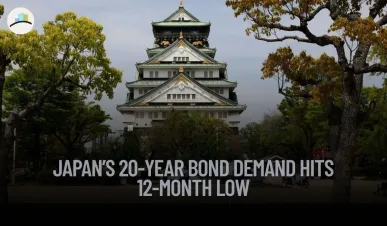
Japan’s Ministry of Finance saw a significant dip in demand during its latest 20-year bond auction. The bid-to-cover ratio, a key gauge of investor interest, dropped to its lowest level in over a year. The auction also recorded a wider-than-expected yield tail, reflecting rising caution among market participants.
This weaker demand came despite relatively stable macroeconomic conditions and is being interpreted as a warning sign for long-term Japanese Government Bonds (JGBs), particularly as the Bank of Japan continues to scale back its support.
More Articles:
BOJ Tapering Exposes Market to Real Price Discovery
The Bank of Japan has spent much of the last decade backstopping Japan’s bond market. However, with inflation trending toward its 2% target and interest rates gradually normalizing, the BOJ has been reducing its JGB purchases.
The result is a market now operating with more price discovery—and, in turn, more volatility. Investors are adjusting to this new dynamic where central bank buying can no longer be relied upon to suppress yields, especially in longer-duration paper like the 20-, 30-, and 40-year bonds.
Demographics and Domestic Demand Shift
Historically, Japanese life insurers and pension funds have been the core buyers of super-long JGBs. Their long-term liabilities matched well with extended maturities. But structural demographic shifts are now reversing that trend. With an aging population and shrinking workforce, these institutions are facing growing liquidity needs and evolving risk mandates.
Additionally, tighter solvency rules have prompted Japanese insurers to shorten their average portfolio durations and reduce exposure to long-end bonds, leaving a vacuum in the domestic demand base that hasn’t yet been replaced.
Market Liquidity Remains Thin in the Long End
One of the less-discussed challenges facing Japan’s bond market is the relatively poor liquidity in ultra-long maturities. Even minor shifts in allocation or supply can cause disproportionate movements in yield. The recent auction saw a significant tail, meaning a broader gap between the average and the lowest accepted yield—an indicator of increased investor uncertainty and low bidding conviction.
This thin liquidity has compounded the issue, making it difficult for investors to adjust portfolios without materially moving the market.
Fiscal Overhang and Policy Jitters Add Pressure
Japan’s government debt-to-GDP ratio remains the highest among developed economies—above 250%. That towering fiscal burden adds complexity to bond issuance strategy, especially as yields start to creep higher. The rising cost of debt servicing could limit the government’s ability to maintain its current trajectory of funding, particularly if demand at the long end remains weak.
Compounding this concern are fears that the Ministry of Finance may be forced to issue more long-term debt in the near future to lock in funding costs, further weighing on demand.
Japan’s 20-year bond sale saw demand that was slightly lower than its average over the past year https://t.co/F2tBx2Orzk
— KeySignals (@KeySignals) June 24, 2025
What to Watch Going Forward
1. BOJ’s Forward Guidance on Tapering
Investors will closely monitor any changes to the BOJ’s pace of tapering or comments from Governor Ueda that hint at renewed support, especially in light of volatility in long-term bonds.
2. Adjustments in Issuance Strategy
The Ministry of Finance could shift issuance toward shorter maturities, where demand is relatively healthier, helping ease pressure on the long end of the curve.
3. Evolving Foreign Investor Participation
If domestic institutional demand continues to retreat, foreign investors may become increasingly important. However, their appetite is highly sensitive to yield and currency risk, which introduces more volatility.
4. Yield Curve Shape and Repricing Risk
The steepening of Japan’s yield curve is likely to continue if long-term yields rise faster than short-term ones. This could ripple into pricing for corporate bonds and mortgages, indirectly tightening financial conditions.
Conclusion: A Structural Repricing Underway?
While one weak auction does not mark a trend, the recent 20-year bond sale reflects growing discomfort among investors with long-term Japanese debt. Without the BOJ acting as a stabilizer, and with demographic and fiscal realities constraining traditional buyers, the market may be entering a period of structural repricing. Investors will need to prepare for greater volatility in Japan’s bond market as the old anchors—central bank buying and domestic demand—continue to weaken.
Disclaimer:
This article is intended for informational purposes only and does not constitute investment advice. Procapitas does not provide personalized financial recommendations. Always consult a licensed financial advisor before making investment decisions. Information is based on publicly available sources as of June 2025 and Procapitas’ independent research and analysis.



