
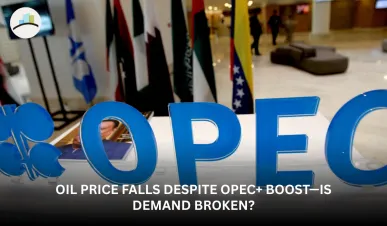
Oil Falls Despite OPEC+ Move — Are Markets Signaling a Deeper Crisis?
As oil prices dip following OPEC+’s greenlight for a production hike, global investors are less focused on supply shifts and more concerned about an unsettling possibility: what if the world simply doesn't need as much oil anymore?
Despite what looks like a straightforward supply-driven story, the decline in crude isn’t just about barrels. It’s about belief—belief in sustained growth, industrial activity, and consumer resilience. And that belief, increasingly, appears fragile.
Why Is This Important?
The OPEC+ decision to increase production was expected to stabilize prices, not sink them. Yet crude futures slid, dragging sentiment across Asian markets. Investors are reading between the lines—and they don’t like what they see.
This matters because oil has always been a proxy for global economic health. When oil demand looks shaky, it’s often a warning light for broader industrial weakness, trade slowdowns, or looming recessions. If prices continue to fall despite tighter control, it may mean the engine itself—global demand—is faltering.
More Articles:
What's Not Being Discussed Enough?
1. Soft Demand in Emerging Asia
While China typically takes the heat for sluggish commodity consumption, Southeast Asia—long considered the "next growth engine"—is quietly underperforming. Falling manufacturing exports from Vietnam, Malaysia, and Indonesia suggest structural issues beyond cyclical dips.
2. India’s Policy Dilemma
India, a major oil importer, stands to benefit from lower crude prices. But here’s the catch: the government’s fuel subsidy structure is based on assumptions of price stability. Prolonged volatility complicates the fiscal roadmap and could delay capex plans or social spending.
3. Shifting Strategic Alliances
The oil market has historically reflected geopolitical tension—now it’s reflecting geopolitical fatigue. As nations pivot toward self-reliance and cleaner energy, OPEC+ influence may be waning. The bigger risk? A disjointed energy market without a global anchor.
Hidden Risks and Opportunities
Risk: Margins May Disappear Fast
Refiners and petrochemical players enjoy short-term margin boosts when oil falls. But the same fall compresses pricing power for downstream products. If demand doesn't pick up, those gains evaporate.
Risk: Mispriced Risk in Financial Markets
Global indices have barely priced in the chance of synchronized stagnation. If oil continues to fall alongside copper, shipping rates, and credit flows, equities may face a delayed correction.
Opportunity: Time for Energy Rebalancing
For governments and companies alike, this is a chance to reduce oil-linked liabilities. Diversifying energy sources now—while oil is cheap—could deliver long-term fiscal and operational resilience.
Historical Echoes
The situation evokes the 2015 crude collapse, but with sharper contradictions. Then, oversupply was clear and demand was weak. Today, OPEC+ is signaling control, yet markets are ignoring it. When the price ignores the cartel, the story shifts from supply to trust—and trust, once lost, is hard to regain.
Final Thought
This isn’t just about oil. It’s about how fragile the post-pandemic recovery may be. Markets are asking: what if we’ve overestimated how fast the world is growing?
Disclaimer:
This article is for informational purposes only and does not constitute investment advice or a recommendation to buy or sell any securities. Procapitas does not provide personalized financial advice. All investment decisions should be made in consultation with a licensed financial advisor. The information presented is based on publicly available sources and Procapitas’ independent research and analysis, which are believed to be reliable but are not guaranteed for accuracy or completeness.



