
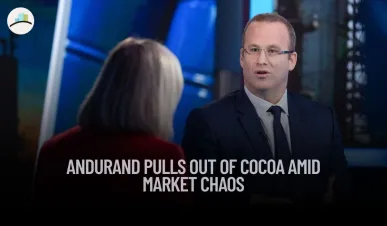
Pierre Andurand, one of the most prominent names in the commodity hedge fund world, has scaled back his exposure to cocoa markets following one of the most volatile and damaging commodity swings in recent memory. The move marks a major retreat from a position he had long championed, based on structural supply shortages and what he viewed as underpriced risk in cocoa. However, despite strong fundamentals supporting a bullish cocoa thesis, the sheer pace and unpredictability of price swings—fueled by thinning liquidity and speculative exit—forced a reassessment.
More Articles:
In the broader context of 2025’s commodity markets, this decision is emblematic of a shift across macro and commodity funds toward risk mitigation over conviction-based concentration. The cocoa market’s historic rally—fueled by fundamental supply constraints—became increasingly disorderly. This retreat, therefore, is less a repudiation of the cocoa narrative and more a recognition of the operational and execution risks inherent in tightly wound, illiquid markets.
Why Cocoa Turned from Sweet to Sour
While cocoa's price performance has been impressive over the past 18 months, the conditions that supported the rally also became its Achilles heel.
Supply shocks and deteriorating fundamentals have driven cocoa inventories to multi-decade lows. Diseases like swollen shoot virus have ravaged plantations in Ivory Coast and Ghana, the world’s two largest producers. Meanwhile, extreme weather events exacerbated by climate change have disrupted harvest cycles, creating a scenario where multi-year deficits are almost inevitable.
At the same time, liquidity in cocoa futures markets has deteriorated sharply. Hedge fund participation, once robust, has withered under the weight of margin volatility and capital preservation priorities. As speculative players exited, bid-ask spreads widened, and price discovery mechanisms broke down. Markets became prone to sudden gaps, triggering unexpected drawdowns—even on otherwise technically sound positions.
Further complicating matters are new geopolitical headwinds. Trade frictions between the U.S. and Latin America, alongside tighter financial regulation in the EU, have created uncertainty around the processing and exporting of soft commodities. Additionally, new tariffs and commodity-linked ESG mandates have added cost layers that are hard to model in futures pricing.
Performance Pain: From Peak to Trough
Andurand’s pullback was not preemptive—it followed a string of performance setbacks. His flagship fund, the Commodities Discretionary Enhanced Fund, had posted spectacular returns in 2023, riding a wave of bullish momentum across metals, energy, and agricultural commodities. However, 2024 and early 2025 proved treacherous.
By August 2025, the fund was down nearly 60 percent year-to-date. The cocoa position was a key drag. The issue wasn’t directionality—Andurand was largely correct in anticipating rising prices—but the execution risks of trading in an illiquid and speculative market. His position faced aggressive margin calls during rapid sell-offs, while price gaps made hedging strategies ineffective.
This episode illustrates how even well-researched, fundamentally sound commodity bets can turn against investors when market mechanics start to break down.
Procapitas Insights: Risk Lessons from the Exit
The story of Andurand’s cocoa bet offers deeper insights that extend beyond soft commodities and into broader fund strategy design.
-
Don't chase structural deficits blindly. A bullish supply-demand imbalance can underpin price direction, but without liquidity, that same narrative can amplify volatility. Fundamental insights need to be married to real-time risk metrics.
-
Model market behavior, not just fundamentals. Real-world commodity trading is shaped not only by production and consumption but also by how futures markets behave during stress. Factors like deliverability, margin dynamics, and speculative exits should be modeled in parallel to supply/demand fundamentals.
-
Beware of speculative crowding. The mass exit of hedge funds from the cocoa market left the field vulnerable to abrupt re-pricing. When a trade becomes too consensus-driven, it risks becoming reflexively unstable, especially when volatility spikes.
-
Tactical hedging is essential. Pure long exposure can be risky even in seemingly "obvious" bull markets. Structured products, optionality, and diversified commodity pairs may offer better risk-adjusted returns.
-
Diversify both across and within commodities. Andurand’s positions in copper and other cyclical commodities also suffered due to global policy shocks. Concentration—even if diversified across different commodities—can increase risk if global factors like trade or inflation policy affect them all simultaneously.
Strategic Outlook: What’s Next in Cocoa?
Despite the retreat, cocoa's long-term outlook remains bullish. Supply remains structurally constrained, and demand for processed chocolate and cocoa butter has continued to grow in emerging markets. However, the path forward will likely be marked by increased caution among large institutional investors.
The challenge now is designing exposure that is resilient to illiquidity, sudden margin spikes, and execution complexity. Traders are likely to pivot from futures-heavy strategies to more nuanced ones involving tolling agreements, swaps, or physical delivery contracts. Additionally, firms may invest in on-the-ground intelligence in West Africa to more accurately predict supply shifts and pricing behavior.
As for Andurand, this move doesn’t signal an abandonment of cocoa—but rather, a tactical withdrawal. It's likely that his fund will re-enter the market when conditions stabilize, using more capital-efficient and risk-controlled instruments.
Disclaimer:
This article is for informational purposes only and does not constitute investment advice or a recommendation to buy or sell any securities. Procapitas does not provide personalized financial advice. All investment decisions should be made in consultation with a licensed financial advisor. The information presented is based on publicly available sources and Procapitas’ independent research and analysis, which are believed to be reliable but are not guaranteed for accuracy or completeness.



