
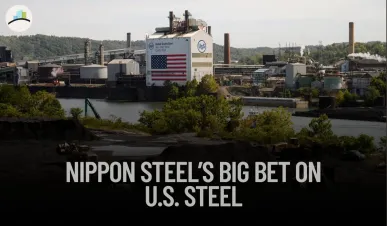
Japan’s largest steelmaker, Nippon Steel Corporation, is making headlines with its massive $14.9 billion agreement to acquire U.S. Steel, one of America’s most iconic industrial companies. The transaction is positioned as a long-term strategic win for Nippon Steel, giving it a solid foothold in the North American market. However, the move is also triggering a wave of scrutiny from both investors and regulators.
This cross-border merger is about more than just market share—it’s about modernizing the global supply chain, integrating technologies, and expanding production capacity at a time when global steel demand is evolving.
More Articles:
The Political and Regulatory Undertone
Part of the deal's complexity stems from a key condition agreed upon with the U.S. government: a "golden share". This unique mechanism gives U.S. authorities the ability to veto critical business decisions concerning national security and strategic operations. While the measure helps ensure continued American oversight over a company with domestic roots, it also adds an unusual governance structure that investors will be watching closely.
This golden share clause was crucial in gaining political support, especially in a climate where foreign acquisitions of American industrial assets often face intense bipartisan scrutiny.
Investor Reactions: Concerns Over Cost and Control
Though the acquisition positions Nippon Steel for growth, it hasn’t been met with universal applause in the market. Investors have grown increasingly cautious, questioning whether the financial and operational risks outweigh the strategic rewards.
Critics point to the $11 billion in planned U.S. investments Nippon Steel has pledged through 2028. These funds will go toward modernizing U.S. Steel’s facilities, boosting productivity, and possibly upgrading technology to match evolving environmental standards. However, such heavy capital commitments could strain Nippon Steel's balance sheet—particularly if the integration process hits operational roadblocks.
Environmental and Sustainability Challenges
With rising pressure on heavy industries to reduce emissions, Nippon Steel has made sustainability part of its post-acquisition agenda. There’s talk of investing in low-carbon steelmaking technologies, such as hydrogen-powered furnaces and carbon capture solutions.
Still, these initiatives are not without cost. Environmental investments could add significant expense over time, and some stakeholders are concerned about how those costs will be managed across a larger, more complex footprint. Critics argue that decarbonizing a combined Nippon–U.S. Steel portfolio could prove more expensive than initially anticipated.
Strategic Value Remains Clear
Despite concerns, the acquisition cements Nippon Steel’s position as a global leader in the steel sector. By taking control of U.S. Steel’s operations, Nippon now has direct access to a mature North American market and some of the most modernized steel facilities in the region.
The deal allows Nippon Steel to spread risk across more geographies, while also offering potential cost synergies in logistics, raw material procurement, and advanced production techniques.
Nippon Steel investors begin to count cost of US Steel acquisition https://t.co/Qp2FY9nUT8
— The Straits Times (@straits_times) June 16, 2025
Outlook: Big Potential, Bigger Expectations
While the transaction has cleared key hurdles, it will take time to evaluate whether the expected benefits will materialize. For investors, the focus now shifts to execution: how well Nippon Steel can integrate a foreign asset under tight political oversight, maintain profitability, and navigate both environmental and regulatory landscapes.
The road ahead is far from smooth—but if successful, the deal could reshape the global steel industry’s power map for years to come.
Disclaimer
This article is based on information from public sources and is provided for informational purposes only. Procapitas does not guarantee the accuracy or completeness of this report. Readers should consult official filings and financial advisors before making any investment decisions.
Source
Bloomberg Article: Nippon Steel’s Investors Begin to Count the Cost of US Win.



