
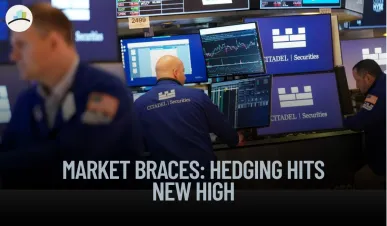
Investors are increasingly reaching for downside protection as the U.S. equity market, particularly the S&P 500, shows signs of vulnerability amid macroeconomic headwinds. Hedging costs—measured by the price of out-of-the-money put options—have surged to their highest levels since mid-2023. This marks a notable shift in sentiment among institutional investors and portfolio managers who had largely remained complacent through most of the 2025 bull run.
What’s driving this spike in protection pricing? A combination of soft labor data, escalating trade disputes, and seasonal volatility patterns are prompting investors to reassess their risk exposure. The renewed appetite for hedges is most evident in the soaring premiums for put options, which act as insurance against steep market drops. These protective instruments are becoming increasingly expensive, particularly for options that guard against 10% or more market declines.
More Articles:
Volatility Indicators Flash Red Flags
Two key measures of market sentiment—namely the Cboe Volatility Index (VIX) and the Cboe Skew Index—are signaling mounting investor anxiety. While the VIX represents near-term expected volatility, the Skew Index captures how much investors are paying for tail-risk protection via far out-of-the-money options. A rising skew suggests that investors are more aggressively hedging against extreme downside scenarios, rather than moderate fluctuations.
This combination of higher implied volatility and skew points to what some analysts describe as a “fragile market ceiling.” In simple terms, even though equities remain near record highs, investors are clearly unwilling to bet on continued upside without insurance.
Historical Context Suggests Strategic Shift
Looking at historical analogues, similar patterns in hedging activity have preceded broader market pullbacks. In the months leading up to the 2008 financial crisis and again before the 2020 pandemic-led crash, hedging costs quietly climbed before the broader market caught up to the underlying risks.
The current situation mirrors those periods not in magnitude but in structure: a mix of complacency at the surface, and subtle hedging undercurrents underneath. Institutional investors are increasingly treating these premiums not as cost centers, but as necessary investments in downside protection.
Why Dynamic Hedging Is Gaining Popularity
Given the rising cost of traditional put protection, several sophisticated investors are turning toward dynamic hedging strategies. One popular approach involves the use of VIX futures or VIX call options funded by the sale of less volatile S&P options. These strategies aim to balance cost and coverage, and they have historically outperformed during periods of market dislocation.
This pivot reflects an acknowledgment that static hedging—buying and holding protective puts—may no longer be efficient in a market with rapidly shifting volatility regimes. Dynamic models adjust protection in real-time, offering more flexible defense mechanisms in an increasingly unstable landscape.
Seasonal Weakness Amplifies Market Sensitivities
Historically, August and September rank among the most volatile months in the equity calendar. This seasonal pattern—driven by lower trading volumes, corporate blackout periods, and macroeconomic uncertainty—often creates fertile ground for exaggerated market movements. Investors are layering these historical probabilities onto current market conditions, leading to a feedback loop where higher hedging demand further inflates pricing.
Moreover, the Federal Reserve's messaging has grown increasingly opaque, especially around the timeline for rate adjustments. This ambiguity, coupled with geopolitical flashpoints like renewed trade tensions, gives hedging strategies a larger role in portfolio construction.
Not Panic, but Preparation
It is essential to distinguish between fear-driven trading and calculated risk management. The current rise in hedging costs is not necessarily a precursor to imminent disaster. Rather, it reflects a market preparing for a broader range of outcomes—including downside scenarios that had previously been dismissed.
Market professionals are not rushing for the exits; they are fortifying their positions. In doing so, they are acknowledging that the economic narrative of 2025 is far from linear—and could pivot rapidly on any number of unpredictable variables, from labor data surprises to policy missteps.
Fear of Stock Market Dive Creeps Back as Hedging Costs Climb - Bloomberg https://t.co/SfpcUFq6CW
— Drmikemyers (@drmikemyers) August 2, 2025
Key Takeaways for Investors
-
Hedging costs are at multi-year highs, indicating institutional caution.
-
Volatility metrics like VIX and Skew show increased demand for tail-risk protection.
-
Dynamic hedging strategies are gaining traction amid cost concerns.
-
Seasonal volatility in August and September is influencing risk behavior.
-
Market sentiment is shifting from complacency to cautious preparation.
Disclaimer:
This article is for informational purposes only and does not constitute investment advice or a recommendation to buy or sell any securities. Procapitas does not provide personalized financial advice. All investment decisions should be made in consultation with a licensed financial advisor. The information presented is based on publicly available sources and Procapitas’ independent research and analysis, which are believed to be reliable but are not guaranteed for accuracy or completeness.



