
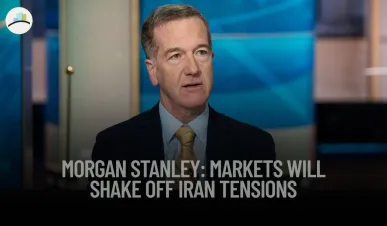
Geopolitical Sell-Offs Are Short-Lived, Says Morgan Stanley’s Michael Wilson
Morgan Stanley’s Chief U.S. Equity Strategist, Michael Wilson, is advising investors to look past the current geopolitical tensions and short-term market jitters. Despite headlines dominated by U.S. military involvement in the Middle East, including recent strikes in Iran, Wilson remains confident that the broader market will absorb and rebound from the shock—just as it has historically done.
His data-backed thesis is simple: geopolitical sell-offs fade quickly. Historically, equities have not only stabilized but often gained momentum in the months following conflict-driven volatility. For Wilson, these moments represent buying opportunities, not reasons to retreat.
More Articles:
Equity Market Resilience Defies War-Time Narratives
Looking back at events such as the U.S. airstrikes in Syria, Russian aggression in Ukraine, or even the assassination of Iranian generals in previous years, the market’s behavior has been surprisingly consistent. Initial sell-offs triggered by fear and uncertainty are often followed by a steady recovery. According to Wilson, this reflects a critical reality: investors are increasingly trained to separate headline risk from actual earnings risk.
As such, he maintains that unless geopolitical conflict materially disrupts economic fundamentals—like oil supply chains, consumer demand, or interest rate policy—the S&P 500 is likely to remain on its growth trajectory.
Oil Prices Still Far from Triggering True Risk-Off Mode
One of the most important gauges in geopolitically charged environments is oil. Wilson notes that while Brent crude has jumped amid tensions in the Middle East, prices are still far from reaching the levels that would cause systemic distress in equities.
Morgan Stanley estimates that oil would need to rise by more than 75% on a year-over-year basis—hitting around $120 per barrel—to meaningfully harm corporate earnings and investor confidence. Current prices, though elevated, remain within the manageable zone, especially for developed-market economies with diversified energy inputs.
Fed Rate Cuts and Strong Earnings Provide a Safety Net
Wilson’s optimism doesn’t rest on geopolitical complacency alone. He believes macro fundamentals are firmly supportive of equities heading into late 2025 and 2026. Morgan Stanley anticipates two rate cuts from the Federal Reserve this year, followed by an easing cycle in 2026. As inflation trends downward and job growth moderates, the Fed is expected to pivot toward economic support.
Meanwhile, earnings-per-share (EPS) growth is projected to hit the mid-teens range by 2026, driven by improving margins, stronger dollar-adjusted exports, and robust consumer spending. Large-cap tech and multinational firms are expected to be the biggest beneficiaries of these trends.
Why Large-Cap Stocks Are Now the Defensive Play
In previous cycles, investors would shift to small-cap or value stocks during early rate cuts. But in this cycle, Morgan Stanley is favoring large-cap, high-margin businesses with global exposure. Companies with pricing power, operational scale, and capital discipline are seen as the safest path through volatile conditions.
Wilson’s team prefers the S&P 500 over the Russell 2000, citing better earnings visibility and resilience. With economic uncertainties and geopolitical risks still simmering, size and quality are being priced as safe havens.
Geopolitical Selloffs Typically Short-Lived: Morgan Stanley's Wilson
— jck✨ (@Alea_) June 23, 2025
Morgan Stanley strategists, led by Michael Wilson, assert that selloffs triggered by geopolitical events, such as recent US strikes on Iran's nuclear facilities, are usually brief. They noted that historical…
Procapitas Insight: Trading the Fear, Not the Fundamentals
What stands out from Morgan Stanley’s outlook is a deeper market philosophy—investors are evolving. Markets now respond less to fear-based narratives and more to underlying economic data. That’s why, even amid geopolitical risks, equities may continue to grind higher, supported by softening interest rates and durable corporate profitability.
Still, this is a tactical calm, not strategic indifference. If the Strait of Hormuz faces long-term disruption, or if oil prices spike beyond current projections, the market narrative could shift quickly. But for now, the thesis is clear: don’t panic—position for the rebound.
Disclaimer:
This article is intended for informational purposes only and does not constitute investment advice. Procapitas does not provide personalized financial recommendations. Always consult a licensed financial advisor before making investment decisions. Information is based on publicly available sources as of June 2025 and Procapitas’ independent research and analysis.



