
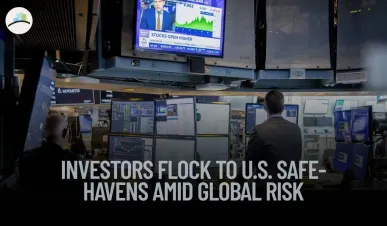
U.S. Assets See Massive Inflows as Global Risks Rise
Over the past several weeks, U.S. equity funds—especially those with exposure to technology—have absorbed more than $30 billion in net inflows. Simultaneously, demand for U.S. Treasuries has intensified, even with long-term yields remaining below recent peaks. The message is clear: global investors are seeking refuge in what they perceive as the most liquid, stable, and reliable financial markets.
This “flight-to-safety” behavior is historically aligned with times of geopolitical tension, uneven economic data, and investor uncertainty about central bank policy trajectories. It reflects a shift from yield-seeking to capital preservation, even if it means sacrificing returns for stability.
More Articles:
Flight-to-Quality Behavior Returns to the Forefront
Safe-haven flows aren’t limited to U.S. Treasuries. Within equity markets, investors are treating mega-cap tech stocks as modern-day safe assets due to their robust cash flows, global scale, and ability to absorb economic shocks. The top five U.S. tech companies now account for a significant portion of global equity fund allocations—a development that, while defensive in nature, may also reflect growing concentration risk.
More than 94% of recent equity inflows have gone into U.S.-dominated funds, indicating that investors are steering away from emerging markets, European equities, and cyclical sectors. Liquidity, predictability, and central bank transparency have all become more valuable than valuation itself.
Europe and China: Diverging from the U.S. Flow
Investors are notably withdrawing capital from regions like Europe and China. Europe is facing stagnation in industrial production, persistent inflation, and political fragmentation, while China is grappling with structural debt issues, weak consumer confidence, and ambiguous policy direction.
These conditions are driving portfolio managers and corporate treasurers to reduce exposure to international volatility and consolidate around U.S. dollar–denominated assets. The strength of the dollar itself is now being reinforced by this wave of capital inflows.
Cash Hoarding and Institutional Hedging on the Rise
It’s not just investors rotating portfolios. Corporations are now holding higher levels of cash on their balance sheets, extending the duration of fixed-income holdings, and favoring short-term liquidity. Institutional hedging activity has increased notably across oil, interest rate, and currency markets, suggesting that many are preparing for prolonged uncertainty rather than betting on a rapid recovery.
The quiet build-up in liquidity preference is perhaps one of the most underappreciated indicators of how seriously risk managers are treating the current market climate.
Dollar Gains as the World Awaits Iran’s Response to US Attack https://t.co/gQ4NbKWdEL
— Gold Eagle Price (@goldeagleprice) June 23, 2025
Procapitas Insight: This Is Not Just a Temporary Repricing
The shift toward U.S. safe-haven assets is no longer just a reaction—it is increasingly looking like a structural realignment of global capital. As growth in China stalls and Europe struggles with political cohesion, the U.S. continues to represent a relative fortress. But this intense capital concentration is also laying the groundwork for potential systemic risk if market sentiment turns.
This is more than a rotation. It’s a redefining of what constitutes “safe” in the modern investment world—and for now, that safety seems to lie firmly within the U.S. financial ecosystem.
Disclaimer:
This article is intended for informational purposes only and does not constitute investment advice. Procapitas does not provide personalized financial recommendations. Always consult a licensed financial advisor before making investment decisions. Information is based on publicly available sources as of June 2025 and Procapitas’ independent research and analysis.



