
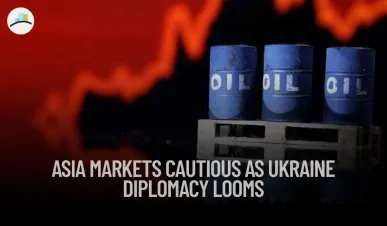
Asian markets opened the week with a tone of caution as investors prepared for a pivotal geopolitical meeting between former U.S. President Donald Trump and Ukrainian President Volodymyr Zelenskiy. The significance of the summit has rippled across global financial centers, with investors bracing for potential diplomatic breakthroughs—or standoffs—that could reframe the market outlook in both energy and defense sectors.
More Articles:
While the Nikkei and Hang Seng indices posted moderate gains in early trading, driven by cyclical stocks and financials, the tech-heavy Kospi struggled under the weight of declining semiconductor sentiment. Investors are balancing expectations of diplomatic de-escalation with growing concerns around the sustainability of tech-led market rallies.
Futures tied to U.S. and European benchmarks edged higher by approximately 0.2%, reflecting cautious optimism. Volatility gauges remain subdued, indicating that while markets are alert, they are not pricing in immediate systemic shocks.
Strategic Signals and Market Anatomy Beyond the Headlines
While the Trump–Zelenskiy summit has dominated media attention, savvy investors are increasingly turning their focus toward less headline-grabbing but structurally vital indicators. Key among these is China’s evolving economic strategy, particularly in light of weaker-than-expected industrial output and a cooling property market.
There is also heightened anticipation ahead of the upcoming Jackson Hole symposium, where Federal Reserve Chair Jerome Powell is expected to signal the trajectory of U.S. monetary policy. The possibility of a dovish shift—perhaps even a rate cut as early as September—has become a meaningful driver of sentiment in Asia’s capital markets.
In Japan and South Korea, realignments in sectoral leadership are also becoming apparent. Defensive plays in utilities and healthcare are seeing renewed investor interest, while the high-beta tech sector—particularly semiconductors—faces headwinds from inventory adjustments and margin compression.
These shifts indicate that while broad-based bullishness is elusive, capital is still actively seeking tactical reallocation in response to global macro signals.
Energy and Defense: Crosswinds Fueling a New Market Narrative
Oil prices declined modestly, reflecting a guarded optimism around possible peace talks. Brent crude fell just below $83 per barrel, signaling the market’s expectation of reduced geopolitical risk premium—though this sentiment remains fragile. Any signal of escalation would likely reverse this dynamic quickly, suggesting that energy prices are entering a phase of volatility rather than stability.
Meanwhile, defense sector equities in Europe and North America have outperformed, driven by political developments that hint at reduced U.S. support for Ukraine. This has fueled concerns among NATO allies, particularly Germany and Poland, prompting new conversations around autonomous defense funding.
For Asian investors, this dynamic introduces new opportunities. Japanese defense contractors, Indian aerospace suppliers, and South Korean missile systems manufacturers are all poised to benefit from the global realignment of military spending. This creates a unique setup in which Asia’s defense sector—often overlooked—is now emerging as a strategic outperformer in the broader equity landscape.
Asia stocks rise, oil slips ahead of Trump-Zelensky talks#Asia #stocks #sharemarket #TrumpTariff #Trump #DonaldTrump #Zelensky #Russia #VladimirPutin #Putin #Ukraine #Moscow #Japan #NIKKEI
— Smart Economy24 (@SmartEconomy24) August 18, 2025
https://t.co/6LdxEPcXC3
Procapitas’ Value-Added Perspective
1. Cross-Asset Sentiment Divergence
Asia’s equity market is no longer moving as a monolith. While tech stocks continue to struggle, segments like industrials, financials, and even consumer staples are starting to outperform, suggesting a recalibration in investor focus. Domestic demand themes, especially in India and Indonesia, are gaining traction as foreign flows diversify away from China-centric bets.
2. Rate Pivot Watch
Traders are currently pricing in an 85% probability of a rate cut by the U.S. Federal Reserve in September. For Asia, this could mean significant inflows into emerging markets and risk assets. This possibility is influencing the behavior of currency markets as well, with regional currencies like the Korean won and Indian rupee showing signs of strengthening against the U.S. dollar.
3. Supply Chain Sovereignty in Focus
One underappreciated trend is the ongoing effort by Asian economies to assert more control over critical supply chains. Countries like Vietnam and Malaysia are doubling down on incentives for semiconductor investment, aiming to become alternatives to Taiwan’s chip dominance. This supply chain diversification theme is likely to be a major investing motif for the next decade.
4. Geopolitics as a Structural Driver
Unlike past market cycles where geopolitical risks were treated as short-term noise, today’s investors are treating them as embedded structural variables. This mindset change is visible in portfolio positioning, where defense, energy security, and commodities are receiving long-term capital allocation rather than tactical bets.
5. China’s Policy Direction: The Silent Catalyst
Beijing’s next move could redefine the trajectory for Asian markets. There are growing expectations for a fiscal stimulus package focused on infrastructure, green energy, and digital innovation. If delivered effectively, such a policy pivot could reignite confidence in the Chinese growth engine—offering upside not just for domestic equities but also for commodity exporters across the region.
Disclaimer:
This article is for informational purposes only and does not constitute investment advice or a recommendation to buy or sell any securities. Procapitas does not provide personalized financial advice. All investment decisions should be made in consultation with a licensed financial advisor. The information presented is based on publicly available sources and Procapitas’ independent research and analysis, which are believed to be reliable but are not guaranteed for accuracy or completeness.



