
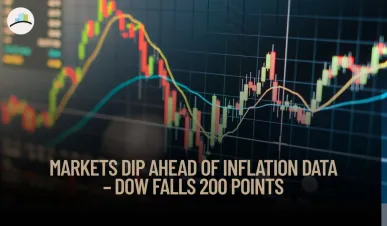
On Monday, August 11, 2025, U.S. stock markets experienced a broad but moderate retreat, as investor sentiment turned cautious at the start of a week expected to deliver key economic data. While the major indexes remain near historic highs, market participants appeared to be stepping back in anticipation of fresh inflation readings that could have significant implications for monetary policy and the broader investment climate.
More Articles:
Major Index Performance
-
Dow Jones Industrial Average
The Dow fell by roughly 200 points, or 0.5%, closing at approximately 43,975. The decline was driven by weakness in heavyweight industrials and tech-adjacent names. Some investors took profits after a multi-week rally, while others reallocated toward more defensive sectors. -
S&P 500 Index
The S&P 500 dropped by about 0.3%, ending the day near 6,373. The index saw a relatively even distribution of losses across sectors, reflecting a general risk-off tone. Defensive sectors slightly outperformed, while growth and cyclical stocks lagged. -
Nasdaq Composite
The Nasdaq Composite also slipped 0.3%, closing near 21,385. Technology shares, which had led much of the market’s advance in recent months, showed signs of fatigue as traders weighed valuations against potential headwinds in earnings and macroeconomic conditions.
Key Factors Driving Market Performance
1. Pre-Inflation Data Caution
Investors were largely in a holding pattern as they awaited two important inflation reports:
-
The Consumer Price Index (CPI), due later in the week, is expected to provide insights into price trends at the consumer level.
-
The Producer Price Index (PPI) will offer a look at inflationary pressures further up the supply chain.
Together, these data points are viewed as pivotal in shaping expectations around Federal Reserve policy. Even modest surprises to the upside or downside could shift the projected timeline for interest rate cuts. This anticipation led to reduced risk-taking and thin trading volumes.
2. Federal Reserve Uncertainty
Recent public remarks from Federal Reserve officials revealed a split in the committee:
-
Some policymakers maintain that inflation, while improving, remains too sticky for comfort. They have expressed reluctance to move too quickly on rate cuts.
-
Others argue that maintaining high interest rates for too long could stifle economic growth and trigger an unnecessary recession, especially as global demand shows signs of slowing.
This divergence has increased uncertainty in fixed income and equity markets, contributing to heightened sensitivity to incoming data.
3. Sector-Specific Weaknesses
-
Industrials:
The Dow was weighed down by stocks like Caterpillar, Honeywell, and Boeing, which declined due to concerns over global industrial demand and potential impacts from delayed infrastructure spending both in the U.S. and abroad. -
Consumer Discretionary:
Nike was among the biggest individual decliners. Analysts cited softer-than-expected global demand, particularly from China, and a lack of near-term catalysts for revenue growth. -
Technology:
Although the tech sector has been a consistent outperformer in 2025, the Nasdaq saw profit-taking in names like Nvidia, AMD, and Apple. Many large-cap tech stocks are trading at historically high forward price-to-earnings ratios, making them vulnerable to shifts in sentiment. -
Financials:
Banks and asset managers were mixed. Some firms are benefiting from higher interest margins, while others are struggling with slower loan growth and increased caution in credit markets.
4. Geopolitical and Trade Tensions
There was heightened focus on U.S.–China trade relations after the Biden administration delayed the rollout of additional tariffs. While this pause was seen as a short-term relief for global supply chains, the underlying trade framework remains uncertain. Investors remain wary of a potential escalation, which could disrupt export-heavy sectors such as semiconductors, machinery, and chemicals.
Furthermore, ongoing geopolitical instability in Eastern Europe and parts of Asia continues to create an undercurrent of risk aversion among institutional investors.
5. Shift Toward Defensive Positioning
The day’s market action suggested that investors are preparing for a possible slowdown in economic activity or a prolonged period of elevated interest rates. As such:
-
Utilities, healthcare, and consumer staples were among the top-performing sectors of the day.
-
Traders also showed increased interest in dividend-paying stocks and short-duration fixed income instruments, which tend to outperform in lower-growth environments.
Pre-Market and Early Trading Trends
In early trading, futures for all three major indexes pointed slightly higher, reflecting optimism about corporate earnings resilience and hopes that inflation data might support a dovish policy stance. However, that optimism faded as the trading session progressed, replaced by concerns over global growth and monetary tightening.
-
Dow futures were up about 0.27% in the pre-market.
-
S&P 500 futures gained around 0.14%.
-
Activity was lighter than usual, with low volatility in options and futures markets—often a signal that institutional players are waiting for a clearer signal before reallocating.
Investor Outlook and Market Sentiment
Despite the day’s losses, sentiment among long-term investors remains cautiously constructive. Most believe that unless inflation accelerates unexpectedly, the Federal Reserve is nearing the end of its tightening cycle. However, few are willing to aggressively buy risk assets without more clarity.
Key short-term questions remain:
-
Will inflation decline fast enough to justify rate cuts in Q4 2025 or early 2026?
-
Can corporate earnings continue to expand despite higher borrowing costs and softening consumer demand?
-
Will global geopolitical risks destabilize the steady macro environment the markets have priced in?
Rise in Tech Earnings Help Asian Markets, Australia Stocks Jump on Anticipated Interest Rate Cut https://t.co/N9U64671lo #stocks pic.twitter.com/o17VUiYfQ0
— InvestorWireNow (@InvestorWireNow) August 11, 2025
Summary
August 11, 2025, was a reflective and cautious day on Wall Street. Investors took a step back from recent gains, positioning themselves ahead of potentially market-moving data on inflation and Federal Reserve policy. Losses were broad but controlled, and while concerns over earnings growth and geopolitical risk remain, the overall tone of the market was more watchful than fearful.
Disclaimer:
This article is for informational purposes only and does not constitute investment advice or a recommendation to buy or sell any securities. Procapitas does not provide personalized financial advice. All investment decisions should be made in consultation with a licensed financial advisor. The information presented is based on publicly available sources and Procapitas’ independent research and analysis, which are believed to be reliable but are not guaranteed for accuracy or completeness.



