
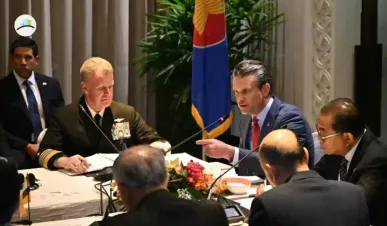
May 31 — U.S. Defense Secretary Pete Hegseth declared Saturday that the United States is prepared to "fight and win" a conflict against China if necessary, reinforcing Washington's hardened military stance in the Indo-Pacific as tensions with Beijing continue to escalate.
Speaking at the annual Shangri-La Dialogue in Singapore, Hegseth issued a strong warning to China over its increasingly assertive actions near Taiwan and in the South China Sea. He emphasized that while the U.S. does not seek confrontation, it will not hesitate to act decisively to uphold regional stability.
"We do not seek conflict, but we are fully prepared to win one if forced," Hegseth said. "Deterrence works best when backed by credible capability and the will to use it."
The remarks come amid deepening concerns within the U.S. and allied governments over Beijing’s recent military maneuvers, including frequent air and naval operations near Taiwan, which China claims as its own.
Also Read:
Canada Q1 GDP Beats Forecasts With 2.2% Growth
Fed Rate Cut Expected in September as Inflation Cools
Strategic clarity over strategic ambiguity
In a notable shift from past U.S. policy, Hegseth's comments underscore a growing preference for “strategic clarity” over the long-standing U.S. approach of “strategic ambiguity” regarding Taiwan. He said the U.S. will continue to enhance military cooperation with allies, maintain freedom of navigation operations in contested waters, and expand defense ties in the region.
The Pentagon chief also reaffirmed commitments under defense partnerships like the Quad (with India, Japan, and Australia) and AUKUS (with the UK and Australia). He confirmed upcoming military exercises and joint deployments across Asia-Pacific bases, including in Japan, Australia, and the Philippines.
China pushes back
A spokesperson for China’s delegation at the summit sharply rejected Hegseth’s comments, accusing the United States of stoking confrontation. Lt. Gen. Jing Guo, speaking shortly after the speech, said, “This kind of rhetoric is dangerous. The U.S. is exaggerating threats and destabilizing the region.”
Despite the public disagreement, U.S. officials said backchannel discussions between Chinese and American military leaders are expected during the summit.
Rising defense investment and market implications
Following the speech, U.S. defense stocks moved higher amid expectations of increased regional defense spending:
-
Lockheed Martin rose 1.3 percent
-
Raytheon Technologies added 0.9 percent
-
Northrop Grumman gained 1.1 percent
Analysts said the comments could accelerate defense procurement efforts among U.S. allies in Asia, particularly those facing pressure from China’s expanding presence.
What's next
Hegseth is scheduled to hold bilateral meetings with defense ministers from Japan, India, and Australia over the weekend. The Chinese delegation is expected to deliver its official remarks on Sunday, where further rebuttals to U.S. claims are likely.
Upcoming congressional defense hearings in Washington are also expected to focus on U.S. force posture in the Pacific and funding for key alliances.
Source: CNBC



