
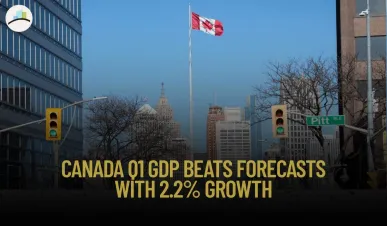
Canada’s economy outpaced expectations in the first quarter of 2025, expanding at an annualized rate of 2.2%, according to data released by Statistics Canada. The figure came in well above analysts’ forecasts of 1.7% growth and was largely fueled by a significant rise in exports, driven by a sharp uptick in cross-border demand from the United States ahead of impending tariffs under President Donald Trump’s administration.
More Articles:
Exports Drive Growth Amid Tariff Uncertainty
The standout contributor to the first-quarter performance was a surge in Canadian exports. U.S. companies, anticipating trade restrictions and higher costs from the proposed tariffs on Canadian goods, moved swiftly to stockpile supplies in advance. This preemptive buying spree provided a temporary but substantial boost to Canada’s export volumes, which helped offset weakness in other areas of the economy.
“The trade front really saved the quarter,” said a senior economist at RBC Capital Markets. “Without that burst in exports, growth would have looked far more subdued.”
Soft Domestic Fundamentals Raise Concerns
Beneath the strong headline number, however, there are growing signs of fragility in the domestic economy. Household spending, a key driver of Canada’s economic engine, showed signs of slowing, as high interest rates and stubborn inflation dampened consumer confidence. Final domestic demand, which excludes exports and inventories, also weakened, indicating a broader pullback in internal economic momentum.
At the same time, increased imports—some of which were likely related to capital goods and consumer items—contributed to a build-up in inventories, reflecting weaker-than-expected sales. Economists warn that this trend may weigh on GDP growth in future quarters if businesses are forced to adjust by slowing production.
Sector Performance: Resilience in Natural Resources
Despite softer domestic demand, several sectors continued to show resilience. Mining, oil and gas extraction, as well as the construction industry, posted gains during the quarter, buoyed by higher commodity prices and robust infrastructure activity in key provinces. These industries helped stabilize overall output and added to the GDP’s upward trajectory.

Monetary Policy Implications
The stronger-than-expected GDP figures have immediate implications for the Bank of Canada’s monetary policy outlook. With markets closely watching for signs of economic overheating or stagnation, the latest data has shifted expectations. According to overnight index swaps, there is now an 82% probability that the central bank will maintain its benchmark interest rate at 2.75% at its upcoming policy meeting.
While inflation remains a concern, the export-driven nature of the Q1 growth may be viewed as transitory by policymakers, potentially giving the Bank room to pause and assess upcoming data before making further moves.
Looking Ahead
Although the headline growth figure is encouraging, analysts caution against overinterpreting a single quarter’s data. Much of the strength was externally driven and may not be sustainable beyond the short term. With domestic demand showing signs of fatigue and geopolitical risks rising, particularly around trade policy with the U.S., the path forward for Canada’s economy remains uncertain.
As the second quarter unfolds, all eyes will be on household spending, business investment, and global trade dynamics to determine whether Canada can sustain its current growth momentum—or if this export-driven burst was merely a temporary reprieve.
Disclaimer:
This article is based on information reported by Reuters and reflects the views of economists and market analysts at the time of publication. It is intended for informational purposes only and does not constitute financial advice.
Source:
Reuters - Canada first-quarter GDP expands by 2.2% annualized rate, beating estimates



