
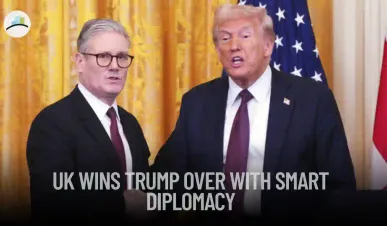
In the unpredictable arena of global diplomacy, few leaders command the erratic loyalty of U.S. President Donald Trump. Yet Britain under Prime Minister Keir Starmer seems to have done just that. In a world still catching its breath from tariff battles, Brexit shocks, and ideological realignments, the U.K. has emerged as an unexpected favorite of Trump’s second-term administration. Why?
The U.K. became the first country to ink a bilateral trade agreement with the U.S. in Trump’s second term, a deal that offered Britain reduced tariffs on cars and steel. But the key lies beyond the fine print: it’s a blend of personality politics, cultural affinity, and strategic economic discipline that has propelled the U.K. into Trump's inner circle.
A Charm Offensive That Worked
Trump’s blunt comment, "Because I like them," may sound unserious, but it reflects a style of foreign policy that leans heavily on personal rapport. Starmer, a center-left Labour leader and former prosecutor, may seem an unlikely favorite for Trump, yet the president has praised him consistently as "a very good person doing a very good job."
The U.K.'s deliberate, non-confrontational diplomacy has played a significant role. When Washington imposed 10% tariffs in April, London chose negotiation over retaliation. This approach, pragmatic rather than ideological, stands in contrast to the tit-for-tat escalations Trump has provoked with China, the EU, and even Canada. It’s a lesson in diplomatic restraint with tangible rewards.
Cultural Affinity and Political Optics
Beyond trade, cultural kinship matters. Trump is an unabashed Anglophile with deep appreciation for British tradition and monarchy. His first state visit in 2019 under Queen Elizabeth II and a recent letter from King Charles have tapped into Trump’s admiration for ceremonial politics—a soft power lever Britain wields with strategic precision.
This cultural connection has real-world implications. Vice President J.D. Vance has even said, "The president really loves the United Kingdom," describing the bilateral relationship as rooted not only in history but shared business ties and familial lineage.
Trade Math and Political Calculus
One of Trump’s core economic grievances is America’s trade deficit. Countries with persistent surpluses—Germany, China, Mexico—often find themselves in Trump’s crosshairs. Britain, by contrast, does not run a significant goods surplus with the U.S. and its services surplus is conveniently overlooked.
Combine this with the U.K.’s low-key handling of recent global crises—including Israel and Ukraine—and it's clear the Starmer administration has calibrated its foreign policy to avoid friction with the U.S. Without loud ideological clashes, the U.K. remains in Washington’s good graces while quietly advancing its strategic interests.
What Isn’t Being Discussed Enough?
While the media fixates on the bromance angle, a deeper concern is emerging: Has the U.K. traded too much autonomy for favor? Aligning closely with a volatile U.S. presidency may yield short-term economic gains, but what happens if the political winds shift? Trump's affection has proven fleeting in the past, with allies like Macron and even Trudeau going from "great friend" to persona non grata.
There's also the risk of alienating the EU, especially as post-Brexit Britain attempts to build a balanced international identity. The fast-track deal with Trump could complicate Britain’s efforts to strengthen trade ties with European neighbors already skeptical of London’s long-term strategy.
More Articles:
The Opportunity Ahead
Still, the opportunity is real. With the U.S. election cycle heating up and global trade in flux, Britain’s early alignment with Trump gives it a head start in shaping future transatlantic standards—especially in tech, digital trade, and defense.
If Starmer can maintain this balancing act—embracing American enthusiasm while retaining European credibility—he may carve out a new, post-Brexit identity for Britain as a bridge between competing global powers.
The Takeaway
The U.K.'s favor with Trump is not just luck; it's strategic positioning, personality politics, and cultural leverage in action. But the durability of this advantage remains uncertain. As history shows, alliances based on personal whims can be as brittle as they are beneficial.



