
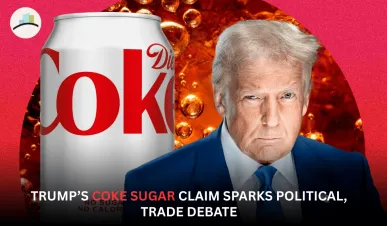
Cane Sugar Politics: Trump Claims Coke Deal, but the Real Story Is Bigger Than Sweeteners
Former President Donald Trump recently claimed that Coca-Cola has agreed to reintroduce real cane sugar into its U.S. beverages — a change that would mark a dramatic shift in one of America’s most iconic products. The beverage giant responded cautiously, neither confirming nor denying Trump’s assertion.
While this may sound like a minor consumer story about sweeteners, it opens the door to a deeper and far more complex discussion about trade policy, health economics, and political theater.
President Donald Trump wrote on Truth Social that he had been in touch with Coca-Cola executives, who he wrote had agreed to produce the nation’s top-selling soft drink domestically using cane sugar, as it is done with Mexican Coca-Cola. https://t.co/5H37m7Ynho
— The Washington Post (@washingtonpost) July 17, 2025
Why Is Trump Talking About Cane Sugar Now?
Trump’s claim isn’t just about soda — it’s about signaling. In an election cycle where economic nationalism, health awareness, and anti-corporate sentiment are front and center, Trump is tapping into multiple voter pain points at once:
-
Health: There’s a growing consumer pushback against high-fructose corn syrup (HFCS), linked to obesity and metabolic disorders.
-
Economics: Cane sugar is more expensive in the U.S. largely because of long-standing protectionist policies supporting domestic corn producers.
-
Global trade: Most countries outside the U.S. already use cane sugar in Coca-Cola. Americans often travel abroad and note the difference in taste and quality.
Trump is leveraging all of these narratives to position himself as a populist who “fixes” American products — not just politics.
The Hidden Political Calculus
What’s not being discussed enough is that this isn’t just a health or taste issue. Trump is once again putting pressure on large corporations to align with his messaging, while simultaneously poking at the corn lobby — a politically powerful force in U.S. agriculture.
By backing cane sugar over corn syrup, Trump indirectly challenges powerful interest groups in corn-producing states like Iowa — ironically, a traditional GOP stronghold. This could lead to political tensions within the party as economic interests and populist messaging collide.
Coca-Cola’s Calculated Silence
Coca-Cola’s muted response is telling. While the company has previously offered real sugar variants in limited runs or international versions, making such a permanent change would involve:
-
Overhauling supply chains
-
Raising production costs
-
Navigating lobbying from both sugar and corn sectors
It also risks triggering wider scrutiny over other ingredients and health impacts — something Coke, and many food giants, carefully manage.
The company may also be wary of being used as a political pawn, especially after previously facing public backlash from both sides of the aisle over its social stances.
MORE ARTICLES
The Bigger Business Implications
If Coca-Cola were to actually make the switch, the economic ripple effects would be significant:
-
Corn industry blowback: Corn syrup producers could lose billions in revenue.
-
Sugar market disruption: U.S. cane sugar suppliers may not currently have the infrastructure to scale rapidly for a brand like Coke.
-
Consumer influence: If the move proves successful, it may force PepsiCo and others to follow, transforming the soft drink industry and potentially food regulation trends.
Historical Parallels
In the 1980s, Coca-Cola quietly replaced sugar with HFCS in the U.S., part of a cost-cutting strategy amid rising sugar prices. Consumers didn't notice at first, but over time, a nostalgia for “Mexican Coke” — still made with cane sugar — grew into a cult following.
If Coca-Cola does reverse this decades-old decision, it won’t just be a recipe change. It will be a historical pivot driven by consumer pressure and political maneuvering.
Why This Matters
This story goes far beyond what’s in your can of Coke. It’s about how political figures can influence corporate behavior — and how corporations walk the tightrope between public image, health concerns, and profit.
Trump’s claim, true or not, has forced a major brand into the spotlight and reignited debates around food policy, trade protectionism, and corporate responsibility. Whether it leads to real change or not, the conversation is already reshaping how consumers — and companies — think about what goes into America’s most iconic products.



