
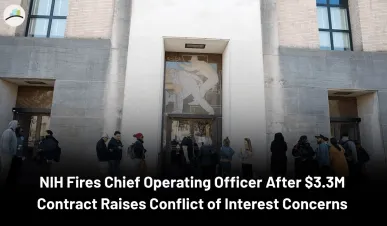
NIH Official Removed After Controversial Contract Involving His Wife Raises Eyebrows
Eric Schnabel, who recently took on the role of Chief Operating Officer at the National Institutes of Health (NIH), has been let go just a few months into the job. The reason? A $3.3 million contract was awarded to a firm that happened to list his wife as one of the team members. That detail alone got a lot of people at the agency, and beyond, asking tough questions.
The whole thing has become a talking point not just because of what happened, but because of what it reveals about how things are run inside major federal agencies like the NIH.
Eric Schnabel (some day a DOGE hire), was fired and escorted out of the NIH Monday amid an investigation into steering a contract on autism and other topics to benefit his wife, Trish.https://t.co/MjznAHJKkL The WaPo story has paywall - you can read free at MSN link pic.twitter.com/hb7BcMlDMD
— Doo Something (@DarnelvaDoo) July 16, 2025
What Really Happened and Why It's a Big Deal
So here’s the situation: Schnabel approved a no-bid contract (that’s when there’s no competitive bidding process) for a firm called Argo Chasing. What raised flags is that his wife, Trish Duffy Schnabel, was named in the contract as a senior analyst. That’s where things got messy. Even if there was no bad intent, the conflict of interest is kind of obvious, and it led to him being dismissed very quickly.
Honestly, it’s not just about one person making a poor decision — it’s a reminder that federal contracting rules are there for a reason. When they’re not followed properly, it breaks trust, and in places like NIH, where billions in public money are spent, trust matters a lot.
What's Not Being Talked About Enough
There’s more going on here than just this one incident. For one, the contract was related to work in areas like autism research and national research security. That kind of work is important, and now it’s on pause. Nobody’s really talking about how this affects the actual research projects or the teams depending on that funding.
Then there’s the internal side. Staff at NIH are already dealing with a lot of change and, to be honest, stress. There’ve been firings, leadership shifts, and debates around how much politics is playing into the science. So this latest incident just adds more confusion and pressure on the people working there every day.
And one more thing: this isn’t the first time concerns about favoritism or unclear contracting practices have come up at NIH. So maybe it’s time for some deeper reflection on how decisions are being made and who’s keeping watch.
MORE ARTICLES
What Could Happen Next
It looks like this might push NIH into making some changes. There's already talk that HHS (the parent agency) is going to do a more in-depth review of how NIH awards contracts. And there could be new rules, like making sure all large contracts go through a bidding process or requiring people to disclose personal connections right away.
On the bigger stage, Congress might also start asking questions — especially since this isn’t just a small mistake. We’re talking about millions in public money being used without proper checks. There’s even a chance that the incident leads to new policies across other federal science agencies too.
For NIH, this could be a moment to rebuild some trust — especially after all the leadership drama and confusion in recent months. But that’s only going to happen if people see real, concrete changes — not just headlines about someone getting fired.
Bigger Picture: Risks and Possible Good That Could Come Out of It
Let’s be honest, this situation shows where the cracks are. When even high-level officials can approve contracts that benefit their family, something isn’t working the way it should. It puts the research community on edge, and that has a ripple effect. Scientists might hesitate to apply for NIH funding, partners might lose confidence, and the public could start questioning how their tax money is being used.
But maybe — just maybe — this could also be the push NIH needs to get things right. A more open, honest system for how money is spent. Stronger rules that apply to everyone, no matter how senior. And better tools to catch problems early, before they become public scandals.
If that happens, then at least something good will come out of this uncomfortable moment.



