
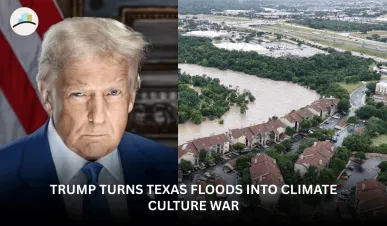
Trump's Texas Disaster Visit: A Preview of Politicized Climate Response in 2025
Former President Donald Trump’s visit to hurricane-ravaged Texas this week, framed more as a political rally than a unifying disaster response, marks a troubling evolution in how climate catastrophes are weaponized in U.S. politics. Far from a moment of bipartisan solidarity, the event doubled down on a populist narrative that divides “real Americans” from federal elites — further politicizing climate relief and emergency governance.
Why Did This Happen?
Trump’s visit to East Texas, a region devastated by flooding and infrastructure failures, comes at a critical moment — not just for the state, but for the nation’s political climate. He seized the opportunity to paint the Biden administration as indifferent to red states’ suffering, accusing federal agencies of "abandonment" and "climate extremism."
This is not just campaigning; it's part of a deliberate strategy to reframe natural disasters as ideological battlegrounds. By invoking “us vs. them” rhetoric, Trump is galvanizing rural and conservative voters who increasingly view Washington’s climate agenda as economically harmful and culturally alien.
What’s Not Being Discussed Enough?
-
Disaster relief as a wedge issue:
Historically, U.S. presidents have used disaster visits to project unity. Trump is flipping the script — turning crisis zones into campaign stages, thus eroding trust in neutral federal disaster governance. -
Climate fatigue in conservative states:
Texas has endured back-to-back natural disasters. While scientists point to climate change, Trump’s framing suggests these communities are being punished for resisting green policy — a narrative resonating with voters exhausted by costly adaptation measures. -
Insurance and risk displacement:
Insurers are pulling out of high-risk zones like coastal Texas due to repeated billion-dollar events. This financial shift is rarely politicized — yet Trump could exploit it as another sign of “elite abandonment,” despite its market-driven origins.
More Articles:
Hidden Risks and Opportunities
-
Risk: Undermining FEMA and federal trust
If disaster response becomes a partisan issue, FEMA’s authority and efficiency could erode, making recovery slower and less effective — particularly in politically divided states. -
Risk: Climate migration politicized
As more Americans flee high-risk zones, internal migration patterns may begin reflecting political identities, further dividing the country demographically and ideologically. -
Opportunity: Local resilience leadership
This vacuum opens the door for mayors and governors to lead climate adaptation — a chance to build bipartisan momentum at the local level, especially where federal leadership is distrusted.
Historical Parallel
In the wake of Hurricane Katrina (2005), President Bush faced massive backlash for a sluggish federal response. But the difference today is intentional division: Trump’s approach weaponizes disaster, not just mismanages it. The storm is no longer just the crisis — it’s the campaign.
Why This Is Important
This event is a litmus test for how the U.S. will respond to the climate era's harshest realities. If disaster response continues down this politicized path, it could fracture the very systems meant to hold the nation together in its most vulnerable moments.



