
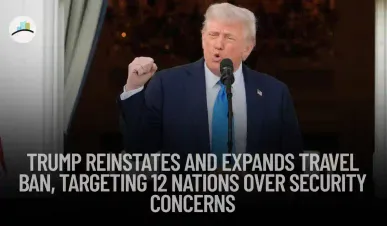
President Donald Trump has signed a sweeping proclamation that revives and expands his earlier travel ban, now blocking entry for citizens from 12 countries and imposing partial restrictions on seven others. The administration cited national security risks and non-cooperation with U.S. immigration standards as key reasons behind the action.
Also Read:
Vietnam Ends Two-Child Rule to Tackle Falling Birth Rate
Trump Questions Biden’s Final Moves Before Exit
Full Ban on 12 Nations
The new proclamation, signed on June 4, bars entry for nationals from:
-
Afghanistan
-
Myanmar
-
Chad
-
Republic of the Congo
-
Equatorial Guinea
-
Eritrea
-
Haiti
-
Iran
-
Libya
-
Somalia
-
Sudan
-
Yemen
According to U.S. officials, these nations either fail to provide adequate identity verification systems, have weak cooperation on deportations, or are designated as high risk for terrorism and overstays.
Partial Restrictions on Seven More
The following countries face limited travel restrictions, mostly affecting certain visa categories or specific traveler types:
-
Burundi
-
Cuba
-
Laos
-
Sierra Leone
-
Togo
-
Turkmenistan
-
Venezuela
Why Now? Background & Trigger
The move comes shortly after a deadly antisemitic attack in Boulder, Colorado, involving an Egyptian national on an expired student visa. Though Egypt is not included in the ban, the incident has reignited debate over the effectiveness of current U.S. visa controls.
“America cannot afford to take risks with its national security,” Trump stated at a press briefing. “We are being firm with nations that refuse to share basic data or cooperate on removing illegal entrants.”
Trump bans citizens of 12 countries from entering the U.S. https://t.co/g1qcXjhgo6
— LivingMediterranean (@LivingMedLife) June 5, 2025
Historical Context: A Familiar Policy
The new order mirrors Trump’s earlier travel bans during his first term. That policy—initially dubbed a "Muslim ban" by critics—was legally challenged but ultimately upheld by the U.S. Supreme Court in Trump v. Hawaii (2018).
Critics argue this expansion disproportionately targets Muslim-majority and African nations. Supporters say it reflects legitimate security concerns, not racial or religious bias.
“These countries have shown a consistent lack of cooperation on critical security measures,” said a DHS spokesperson. “The risk to American lives is real and proven.”
Legal Landscape & Expected Pushback
Civil rights organizations have already signaled they will challenge the new order in federal courts. The ACLU called the policy “xenophobic and deeply un-American,” while legal experts question whether it will hold up if it appears discriminatory in intent.
However, administration lawyers argue that the travel ban is built on the same legal foundation upheld in 2018: that the president has broad authority to restrict entry to protect U.S. interests.
Exemptions & Waivers
Notably, the proclamation includes exceptions for:
-
U.S. lawful permanent residents (green card holders)
-
Those with valid current visas
-
Individuals traveling for urgent humanitarian reasons
-
Athletes participating in global competitions
-
Persons whose entry is deemed in the national interest
All decisions will be made at the discretion of U.S. consular officers and DHS officials.
What's Next?
The proclamation takes effect within 21 days, giving embassies and consulates time to adjust visa processing. Lawsuits are expected shortly after implementation. Political analysts say the move is likely to energize Trump’s base ahead of the 2025 campaign season, particularly on immigration issues.
Timeline: U.S. Travel Ban Policy (2017–2025)
-
Jan 2017: First travel ban targets seven Muslim-majority nations.
-
Jun 2018: Supreme Court upholds revised ban (Trump v. Hawaii).
-
Feb 2020: Expansion adds six African countries.
-
Jan 2021: Ban revoked by President Joe Biden.
-
June 2025: Trump reinstates and expands travel restrictions.
Source: CNBC



