
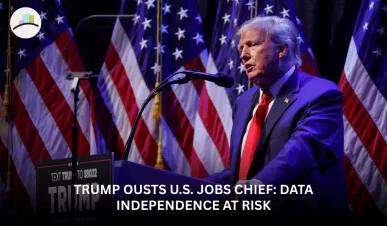
When Job Numbers Bite Back and Politics Strikes
In an audacious move, President Trump abruptly dismissed Erika McEntarfer, the Bureau of Labor Statistics (BLS) chief, shortly after the release of a weaker‑than‑expected jobs report. While political appointments are routine, this marked the rare intersection of personal accountability and public data, raising questions about the independence of a body once considered untouchable.
Court watchers and economists alike are asking: Why fire the stats boss over numbers you can’t spin? And what happens when leading indicators become political targets?
Unquestionably the most dangerous and corrupt attack on independently validated US economic data in American history.
— Vertex (@BurtonPixels) August 1, 2025
Trump is firing the head of the Bureau of Labor Statistics, a civil servant confirmed 86-8 by the Senate, because job numbers tanked due to his stupid policies. pic.twitter.com/UUe8I5E3AS
Why This Matters
-
Data Independence Under Threat
The BLS is meant to be a pillar of methodological rigor—not a political tool. Terminating its director for reporting reality puts statistical credibility at risk, undermining trust in every indicator from inflation to payroll growth. -
Markets Will Listen
Investors and markets cherish transparency. If the messenger can be removed for delivering unwelcome news, confidence in macroeconomic releases may wobble—potentially unsteadying bond and equity markets. -
Election-Year Undercurrents
With the election looming, job growth numbers are politically charged signals. Replacing key officials for perceived “bad optics” could become a pattern of control rather than correction.
MORE ARTICLES:
What Isn’t Being Talked About Enough
-
Internal Morale and Turnover Costs
Removing a top career official under political pressure sends tremors through the civil service. Qualified economists inside the agency may retreat from publishing insight or resign altogether, diluting long-term institutional knowledge. -
Legal and Institutional Precedent
While the President has appointment power, firing for policy isn’t standard. It may invite lawsuits over misuse of power and open a debate on whether labor statistics should be enshrined in law as independent. -
International Comparisons
Many advanced economies protect statistical bodies with statutory independence. U.S. data may now be viewed as susceptible, diminishing its weight in global economic analysis.
Risks & Opportunities Table
| Risk | Opportunity |
|---|---|
| Shrinking public trust in official statistics | Calls for legislative protection of data agencies |
| Flight of expert analysts from BLS | A chance to codify transparency standards |
| Market disruption if numbers seem manipulated | Opening to alternative independent data platforms |
Historical Parallels
Though U.S. history lacks many interventions of this kind, similar moves in other countries have led to data skepticism. In the UK and Italy, politicizing statistics corresponded with rising inflation distrust and diverging private indicators. That erosion aligned with weaker policy credibility and turbulence in policymaking.
Fresh Angles Worth Watching
-
Could Congress pass a bill insulating the BLS from politically motivated firings?
-
Will private data ventures and think‑tanks gain traction if official reports lose perceived legitimacy?
-
Will markets begin pricing in a “political risk premium” on U.S. data releases?
-
Will civil society step in to defend transparency and whistleblowing within public agencies?



