
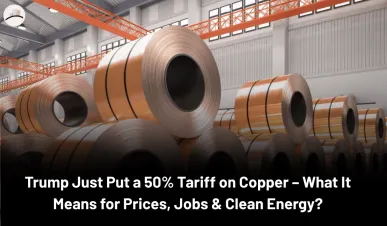
So What Just Happened?
Alright, here’s the big update — the Trump administration just announced a 50% tariff on all copper imports starting next month. And yeah, that’s a huge number. The reason? They say it’s about national security and making sure we don’t depend too much on other countries for materials we use in everything from power grids to electric cars. Trump’s team also mentioned they want to bring back copper refining jobs to the U.S., saying this will help the economy in the long run. But let’s be real — the timing and scale of it feel like a bold power move, not just a trade decision.
Copper isn’t just another metal. It’s used in almost everything – electric vehicles, smartphones, construction wiring, solar panels, and more. It’s one of those materials that quietly keeps modern life running. So when the government suddenly makes it a lot more expensive to bring in from outside, a whole lot of industries are going to feel it.
🇺🇸 PRESIDENT DONALD TRUMP SAID HE WILL IMPOSE A 50% TARIFF ON COPPER IMPORTS. pic.twitter.com/l3oaDcnI1v
— ThuanCapitalGlobal (@ThuanGlobal) July 8, 2025
What People Aren’t Talking About Enough
Most headlines are just focusing on the tariff number, but they’re kind of skipping over some really important stuff. First off, this is going to make clean energy more expensive. EVs, solar panels, and even wind farms all need a lot of copper. So if copper prices shoot up — and they already jumped 13% after the announcement — then all those green projects get more expensive too. That could slow things down at a time when the world is trying to go faster with clean energy.
Also, the U.S. doesn’t currently have enough refining capacity to process all the copper it needs. Even if we mine more here, a lot of the raw material still goes overseas for processing. China actually controls a big chunk of that part of the supply chain. So this tariff is also about pushing back against that control, without directly naming China. It’s a national security thing, yes — but also a quiet way to shift global influence.
Who’s Benefiting and Who’s Not?
Some U.S. mining companies are definitely happy. Stocks like Freeport-McMoRan went up right after the news because investors think this will lead to more American mining and refining. That’s good news if you work in that space or invest in it.
But on the flip side, manufacturers are probably stressed. Think of carmakers, electronics companies, builders — anyone who needs copper to make or fix things. Their costs are about to go up, and they’ll either have to eat those costs or pass them on to consumers. So yeah, this could show up in the price of new homes, EVs, appliances, and even your electric bill down the line.
It’s not just about dollars either. This might lead to slower production or paused projects while companies figure out how to deal with the higher copper prices.
MORE ARTICLES:
Bigger Picture: Is This Like the Steel Tariff All Over Again?
Honestly, this feels pretty familiar. Back in 2018, Trump placed tariffs on steel and aluminum. There was a similar goal — bring production back, protect jobs, reduce reliance on imports. And while some jobs did come back, prices also went up and some industries actually struggled with the added cost.
Now it looks like we’re going down that same road, just with copper. And this time, the stakes might be higher. Why? Because copper is essential to the clean energy transition, and demand is only going to keep rising. So if supply gets more expensive or harder to access, it could slow down some pretty important progress — especially with EVs and renewable energy.
Could This Backfire?
There are definitely some risks here that aren’t getting enough attention. For one, inflation. Copper is used in tons of products. If those start to cost more, it could push up overall inflation again, just when things were starting to cool down.
Then there’s the risk of retaliation. Countries like Chile and Canada, who sell a lot of copper to the U.S., might respond with their own tariffs. That could hit U.S. exports — maybe even in totally different industries, like agriculture or tech.
And don’t forget the execution risk. Even if the plan is to build up U.S. copper production and refining, that doesn’t happen overnight. It takes time, investment, permits, skilled labor — and we’re not exactly overflowing with all of those right now.
What This Might Mean Going Forward
This move is probably just the beginning. There’s already talk of even more tariffs, possibly on pharmaceuticals and other key imports. It seems like the Trump administration wants to reset how much the U.S. depends on other countries, especially for critical materials and technologies.
In the meantime, American companies are probably going to be busy figuring out how to keep things running without letting costs spiral. Expect to hear more about supply chain shifts, price increases, and possibly new lobbying efforts from both industry groups and clean energy advocates.
Final Thought
This new copper tariff may look like just another trade policy, but it’s actually a pretty big shift. It touches so many parts of the economy — from mining and manufacturing to clean energy and global diplomacy. Some people will gain from this, but many others will have to adjust quickly. It’s a reminder that decisions like these don’t just affect politicians or CEOs — they trickle down into the prices we pay and the technology we rely on.
Let’s see how fast the U.S. can build up its own copper capabilities — and whether the long-term benefits will actually be worth the short-term price hikes.



