
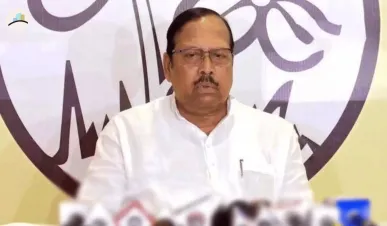
TMC Founding Member Sukhendu Sekhar Ray Quits Rajya Sabha as MLA Rebellion and Parliamentary Dissent Signal Deepening Party Crisis
The 77-year-old veteran's resignation on June 8, submitted hours before a key INDIA bloc meeting in Delhi, follows an unprecedented rebellion in which 58 TMC MLAs broke ranks with the party leadership in West Bengal making Ray the first TMC MP to quit in the wake of the party's 2026 electoral setback.
The Trinamool Congress faced its most significant simultaneous pressure on two fronts on Monday in Parliament and in its home state as founding member and Rajya Sabha MP Sukhendu Sekhar Ray resigned from both the party and the Upper House on June 8, 2026, compounding an already active rebellion among the party's newly elected state legislators.
Ray, one of the founding members of the TMC and among its most recognisable faces in Parliament, announced his decision in the national capital hours before a meeting of the INDIA bloc, to be attended by West Bengal Chief Minister Mamata Banerjee and party national general secretary Abhishek Banerjee.
The resignation is significant not merely because of Ray's seniority, but also because it marks the first high-profile departure from the TMC's parliamentary wing since the internal turmoil began. Political observers said the development assumes added significance as it unfolded in Delhi, while the party's top leadership was engaged in consultations with opposition allies at the INDIA bloc meeting.
Other Stories-
-Private Jet Emergency Landing in Flames in Dominican Republic: 2 Dead, Video Surfaces
-Tsunami in Multiple Countries After Philippines Earthquake: Full List & Aftershocks
-Israel Strikes Iran After Iran Missile Barrage: Full Update, Explosion Reports & War Escalation
Ray's stated reasons
Ray told reporters in New Delhi that he was increasingly cornered within the party after he spoke out on the RG Kar issue. He also alleged that corruption was rampant in many sectors during the TMC's rule, and that public anger against it had reached such a point that an electoral setback was a matter of time.
Ray's dissent with the party leadership is not new. In September 2024, Ray had resigned as editor of the TMC's party mouthpiece Jago Bangla after repeatedly striking discordant notes over the rape and murder of a postgraduate trainee doctor at RG Kar Medical College and Hospital in Kolkata. He had also been summoned to Kolkata Police headquarters after criticising on X the manner in which police handled the case. His public criticism of the party on that issue was one of the earliest visible signs of a breakdown in his relationship with the TMC leadership.
The MLA rebellion: the larger pattern
Ray's exit did not emerge in isolation. His resignation comes barely days after an unprecedented rebellion in the party's legislature wing in West Bengal, where 58 TMC MLAs broke ranks with the leadership and backed Ritabrata Banerjee for the post of Leader of the Opposition, rejecting the party's official nominee Shovandeb Chattopadhyay.
Sukhendu Sekhar Ray became the first TMC MP to step down after the party's crushing electoral loss in West Bengal in May 2026. He had recently said that the developments within the party in Bengal, where three-fourths of its 80 newly elected MLAs walked out to back a dissenting leader, were unprecedented and could have repercussions in Parliament. That warning has now materialised.
Ray's standing in the party
Ray, born on April 5, 1949, has served as a Rajya Sabha MP since August 2011, having previously been a member of the Indian National Congress before joining the TMC. He served as Chief Whip of the TMC in the Rajya Sabha from 2011 to 2024. He is the son of Shibendu Sekhar Roy, a noted Hindu Mahasabha leader who played a key role in uniting the people of Malda during Partition to ensure the district remained within India a legacy Prime Minister Narendra Modi acknowledged at an event in Malda in January 2026.
Parliamentary wing under watch
While no other parliamentarian has publicly expressed dissent, party sources acknowledged that discussions over the future course of several leaders unhappy with the functioning of the organisation are ongoing. The timing of the move has triggered fresh speculation within political circles about the possibility of unrest among a section of TMC MPs.
Whether further resignations from the TMC's parliamentary wing are imminent has not been officially confirmed by any party source.
The unique angle worth noting: Ray's exit follows a clear and documented pattern of dissent that began not in June 2026 but in September 2024, when he resigned as editor of Jago Bangla over the RG Kar case — a move the party did not act on decisively. The MLA rebellion and his Rajya Sabha resignation are therefore the culmination of nearly two years of unaddressed internal dissent, suggesting the TMC's current crisis is less a sudden rupture and more the result of accumulated grievances that the party's centralised leadership structure repeatedly failed to absorb.



