
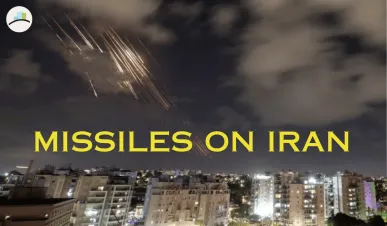
Israel launched airstrikes against military targets in Iran on Monday after Tehran fired a large barrage of ballistic missiles toward Israeli territory, ending a fragile ceasefire and fueling fears of a wider regional war. Explosions were reported in Tehran, Tabriz, Isfahan and other areas as the conflict sharply escalated in its latest phase.
What Triggered the Attack: Tehran’s Missile Barrage
Iran’s military launched multiple ballistic missiles at northern and central Israel late Sunday, the first such barrage since a ceasefire took effect in April. Sirens were heard across Jerusalem and other cities as Israeli air defenses activated to intercept incoming threats.
The Iranian strikes were reportedly framed as retaliation for recent Israeli operations in Beirut and southern Lebanon, where Israel had targeted sites linked to allied militias. Tehran’s missile barrage marked a significant shift from proxy actions to direct engagement with Israel.
🚨Recent terrifying footage:
— Middle Eastern Affairs (@OpsHQs) June 7, 2026
Iran strikes the largest air base in Israel and destroys it." pic.twitter.com/jXkXjukjfq
Israel’s Response: Airstrikes in Iran
In response to the missile fire, the Israel Defense Forces (IDF) said it carried out air and possibly ballistic missile strikes inside Iran, hitting military targets including missile launch infrastructure and command centers in western and central regions of the country. Explosions were heard in major Iranian cities, including Tehran, Isfahan, Karaj and Tabriz.
The strikes marked one of the most direct Israeli attacks on Iranian territory since the conflict began and were described by Israeli officials as a necessary retaliation to protect national security.
MORE ARTICLES:
Ceasefire Shattered: Fears of Wider War
The renewed exchanges ended a tenuous cessation of hostilities that had been in place since April. With both nations directly attacking each other rather than through proxies, analysts warn the risk of a full‑blown regional conflict has sharply increased.
Iran’s Revolutionary Guard has threatened expanded retaliation if Israel continues its campaign, and Tehran’s airspace was temporarily closed following the strikes.
Explosions & Impact Inside Iran
State media in Iran reported loud blasts in multiple cities, with residents describing the sound of explosions shaking buildings and shaking the skyline in Tehran — a rare public acknowledgment of direct foreign strikes. Air defenses were said to be active, and cities reported defensive measures following the Israeli actions.
International Reaction & Diplomatic Pressure
The attacks have drawn warnings from global leaders urging de‑escalation and diplomacy. U.S. officials reportedly pushed Israeli leadership to exercise restraint, emphasising the importance of preventing a broader war that could destabilize the region further and derail ongoing negotiations.
Other nations reiterated calls for dialogue even as military actions unfolded, noting concern over the conflict’s spread beyond the immediate battlefield.
What This Means for the Middle East
- Ceasefire collapse: The direct missile exchanges and retaliatory strikes signal a serious breakdown in temporary peace efforts.
- Broader involvement risk: With Tehran threatening wider retaliation and Israel responding with deep strikes into Iranian territory, analysts fear the conflict could draw in additional regional players.
- Energy & security implications: The Middle East’s strategic importance especially for global energy supplies raises alarm over secondary impacts on oil markets and security cooperation.



