
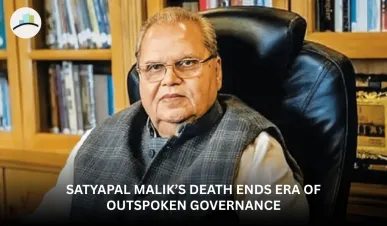
Satyapal Malik’s Death Marks the End of an Unfiltered Political Era
The death of Satyapal Malik, former Governor of Jammu & Kashmir and a long-serving politician, brings to a close a uniquely candid chapter in Indian public life — one that blended establishment credentials with outspoken contrarianism.
At 79, Malik was more than just another face in Indian bureaucracy. He was a rare figure who moved across political aisles, served under multiple regimes, and — in his final years — became a vocal critic of the very power structures he once represented. His passing has left a silence in an already polarized political landscape, but also raises deeper questions about accountability, dissent, and the changing nature of India’s power elite.
Breaking now: Satyapal Malik has passed away. The senior politician and governor found himself in an eye of a storm for taking on the Modi govt. He was never afraid of speaking his mind in a long political journey of many twists and turns. RIP. Om Shanti. pic.twitter.com/iS2hUu3sEE
— Rajdeep Sardesai (@sardesairajdeep) August 5, 2025
Beyond the Headlines: Why This Matters
Malik served as the Governor of four Indian states, most notably Jammu & Kashmir during its abrogation of Article 370 in 2019. He oversaw the politically explosive transition of J&K from a state to two Union Territories — a period marked by communication blackouts, detentions of political leaders, and rising international scrutiny.
But what made Malik politically significant was not just his role in that moment — it was his decision to break ranks afterward. He publicly criticized the Centre’s handling of major events, including the Pulwama terror attack, where he alleged lapses in security protocols and even hinted at bureaucratic indifference.
MORE ARTICLES:
Unspoken Consequences & Political Implications
1. Decline of Institutional Whistleblowers
Malik’s death is symbolic of a shrinking space for internal dissent within India's bureaucratic and gubernatorial ranks. Few high-ranking officials today speak out once they exit office — a norm Malik famously defied.
2. J&K Narrative Gap Reopens
Malik’s tenure in J&K was controversial, but his candid remarks provided a counter-narrative to the government’s version of events post-Article 370. With his passing, there’s a vacuum — no prominent insider now remains to challenge or clarify those decisions from within.
3. The Discomfort of Political Hybridity
Having affiliations with both Janata Dal and BJP at various stages, Malik represented a now-rare breed of politician who could work across ideological spectrums without being ideologically rigid. His career arc challenges the current binary discourse in Indian politics.
Historical Parallel: A Gubernatorial Maverick
Few Indian governors have been as publicly controversial in post-retirement commentary as Malik — a throwback to figures like T.N. Seshan, who redefined institutional roles. Malik's speeches, interviews, and unfiltered remarks often unsettled not just his critics, but also those who once appointed him.
What Is Not Being Discussed Enough?
-
Pulwama Revelations: His claims on security lapses and ignored intelligence ahead of the 2019 Pulwama attack have never been officially investigated or debated in Parliament.
-
Freedom of Speech vs Post-Retirement Gag Orders: Malik’s candor exposed a deeper dilemma — should constitutional post-holders have the freedom to speak after tenure, or be bound by loyalty forever?
-
Systemic Insulation: His remarks hinted at how India’s bureaucratic machinery often operates with minimal oversight and political insulation, especially in conflict zones.
Conclusion: A Polarizing Voice, Now Silenced
Satyapal Malik was not universally admired. Many questioned his motivations, timing, and political leanings. But few can deny that he said what others wouldn’t dare — and did so from the highest echelons of power.
His death is not just the end of a political career. It marks the waning of a culture where governors could be guardians of public interest rather than ceremonial agents of the Centre. In an age of increasing uniformity, his life reminds us what dissent — even if imperfect — can look like from the inside.



