
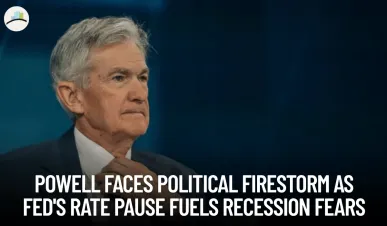
Jerome Powell is heading into the lion’s den this week. The Federal Reserve Chair, famously calm and calculated, will face a not-so-calm and very calculated Congress as lawmakers demand answers on why the Fed is still holding interest rates high — even as Americans continue to feel the pinch of borrowing costs and an economy that doesn’t feel quite right.
The Fed hasn’t raised rates since July 2023, but it also hasn’t cut them. And that’s the problem — at least in the eyes of both Democrats and Republicans, for very different reasons.
This week’s hearing isn’t just another round of monetary wonkery. It’s turning into a moment of political theatre with real-world consequences. Behind the microphones and opening statements lies a deeper anxiety: Has the Fed misjudged the moment?
So, what’s really going on?
On paper, the economy is doing “okay.” Unemployment is low, the stock market has bounced back, and inflation has cooled from its red-hot 2022 highs. But under the surface, there’s growing stress — in household budgets, in business investments, and in political tempers.
Democrats argue the Fed is dragging its feet and leaving ordinary Americans stuck with sky-high mortgage rates, car loans, and credit card bills. They want rate cuts — and fast.
Republicans, on the other hand, are warning the Fed not to "give in" to pressure. They accuse Powell of helping create inflation and now being too politically sensitive to fix it.
And Powell? He’s trying to hold the line, walking a tightrope between caution and conviction.
Why this moment matters more than usual
Normally, the Fed’s hearings are sleepy affairs. But this one could get fiery — and the fallout might not stay inside Washington.
This is a rare convergence of high stakes:
✔️ A fragile recovery that feels like a recession to many.
✔️ An upcoming presidential election that has everyone on edge.
✔️ And a central bank that’s being asked to solve both inflation and inequality — without triggering a downturn.
Behind the headlines is a more personal story: Millions of Americans are watching their paychecks stretch thinner while waiting for relief that hasn’t come. Powell’s words this week won’t just move markets. They’ll ripple through households.
Come join us for the Jerome Powell testimony live! Remember, 2x per year Powell does congressional testimony. Today we have the House. Will this influence markets? Let us know live in our chat! $SPY $QQQ https://t.co/dxZGs4O03P pic.twitter.com/FOo1JmUDIO
— Beginner Trading (@BeginnerTrades) June 24, 2025
What no one’s really talking about
A "silent recession" may already be creeping in.
Forget the GDP numbers for a second. Look at rising credit card delinquencies. Look at small businesses pulling back. Look at how fewer people are moving, buying homes, or taking investment risks. High rates are slowing the economy — it just hasn’t hit the headlines yet.
The Fed may be running out of useful tools.
Interest rate hikes were blunt but effective when inflation was roaring. But now? Rate changes alone might not address the real drivers of today’s inflation — supply chain tightness, housing shortages, labor gaps. Yet the Fed has little else in its policy toolbox.
What could happen next — and why it matters to you
If Powell’s testimony doesn’t go well — if he sounds uncertain, politically cornered, or overly cautious — the Fed’s credibility could take a hit. And that matters.
Global investors watch the Fed like hawks. If they smell hesitation or political meddling, confidence in U.S. monetary policy (and the dollar) could wobble. That means more volatility in everything from emerging markets to your 401(k).
Back home, a rough hearing could spark louder calls in Congress to overhaul how the Fed works. That could range from minor tweaks to bigger moves like limiting its autonomy — something that would have been unthinkable a decade ago.
More Article:
We’ve been here before… kind of
Think back to the 1990s — Alan Greenspan also faced political heat during a period of disinflation and cautious policy. But today’s environment is far messier: inflation has global roots, politics are more combative, and public trust in institutions is lower.
Or rewind to the 1970s, when the Fed — under White House pressure — eased policy too soon and triggered a second inflation wave. Powell has made it clear he doesn’t want to repeat that mistake. But the pressure now is unlike anything he’s faced before.
Expert voices are split
Former Fed Vice Chair Don Kohn recently warned that waiting too long to cut could "tip the balance toward a harder landing." Meanwhile, economist Claudia Sahm sees deeper cracks: “People are changing jobs not because they want to, but because they have to. We’re missing that in the data.”
\Risks on the radar that should be louder
-
The Fed may lose its voice. If Powell plays too safe, the central bank could become more reactive and less trusted. That’s dangerous in an uncertain world.
-
Public frustration could boil over. If families continue to feel squeezed while hearing about “stable inflation,” expect more populist anger toward the Fed — and more political efforts to clip its wings.
-
Global faith in the Fed could crack. Foreign governments and investors rely on U.S. monetary stability. If Powell’s Fed looks political, alternatives (like the euro or yuan) start looking more attractive long-term.
Silver linings — if Powell plays it right
-
A clearer path to smart rate cuts. If Powell manages to sound both calm and flexible, markets could stabilize and the Fed could regain control of the narrative.
-
A chance to evolve the Fed’s toolkit. This moment might spark real conversation about modernizing monetary policy — including better tools for dealing with supply shocks, inequality, and climate-linked risks.
Bottom line
This hearing isn’t just about rates or inflation charts. It’s a test of whether the U.S. still trusts its central bank to steer the ship — even when the waters are politically choppy and economically confusing.
Powell may not have all the answers this week. But how he carries himself — and how Congress reacts — could shape the Fed’s future more than any single rate decision.



