
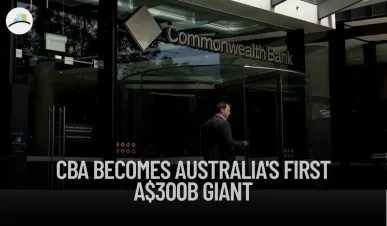
Commonwealth Bank Becomes Australia’s First A$300 Billion Company
Commonwealth Bank of Australia (CBA) has etched its name into the history of the Australian stock market by becoming the first listed company on the ASX to cross the A$300 billion market capitalization mark. This significant milestone follows an impressive stock price rally of nearly 50% over the past 12 months—well ahead of its major banking peers and far outpacing the broader S&P/ASX 200 index.
This meteoric rise is powered by a combination of strong dividend consistency, institutional index exposure, and a resilient retail shareholder base that continues to back the bank despite growing concerns about overvaluation.
More Articles:
The Rally is Less About Performance, More About Sentiment
While CBA’s financial performance remains solid, its valuation metrics are now detached from the underlying fundamentals. The stock trades at nearly 4 times its book value and at a forward price-to-earnings multiple approaching 28—levels more common in fast-growth tech stocks, not mature financial institutions. These valuations outstrip not just other Australian banks but also global heavyweights like JPMorgan Chase and HSBC.
CBA's return on equity remains steady around 13%, which, while respectable, lags behind more efficiently capitalized global peers. Its earnings growth has plateaued, and mortgage stress is rising—especially among fixed-rate borrowers now rolling onto higher rates. Nonetheless, investor confidence remains undeterred, driven by dividend reliability and strong capital reserves.
Index Funds and Tax-Aware Investors Keep the Rally Alive
A crucial component of CBA's upward trajectory is its weight in passive investment indices such as MSCI Australia and the ASX 200. As more capital flows into these index funds, they are compelled to buy more CBA shares due to its outsized weighting. This creates a mechanical demand for the stock regardless of price or valuation—what some analysts refer to as “structural buying.”
Adding to this is the behavior of long-term retail investors, many of whom acquired CBA shares during earlier privatizations. Due to Australia's favorable capital gains tax rules, these investors are reluctant to sell, reinforcing price momentum by reducing the available float.
Institutional Investors Growing Cautious
Despite the euphoria, some large institutional players are beginning to scale back their exposure. Analysts are warning of a possible correction if earnings don’t catch up with the price or if macro conditions shift unfavorably. CBA’s high valuation and heavy index dependence make it vulnerable to sudden outflows, especially if passive inflows slow or reverse due to rate volatility or changes in benchmark weighting.
Moreover, regulators are examining the capital adequacy of major banks, and any shifts in reserve requirements or dividend payout rules could dampen sentiment.
Capital Deployment May Act as a Shock Absorber
CBA is not without tools to support its valuation. The bank sits on substantial surplus capital and has room for increased buybacks or special dividends, which could soften the blow in case of a market pullback. If used strategically, capital deployment may act as a cushion against valuation normalization.
The upcoming results cycle will be closely watched to see whether CBA can justify its lofty valuation with profit growth or will need to rely on capital distribution to appease investors.
CBA hits a $300B valuation — the first ASX-listed stock to do so.
— ₿its on Finance (@bitsonfinance) June 4, 2025
Impressive milestone in a world where money is constantly expanding.
Now imagine what happens when value accrues in a system with a fixed supply.
Bitcoin’s supply doesn’t inflate. It just keeps ticking. 🟧 pic.twitter.com/LxsbgqcC9F
Longer-Term Outlook: Risk Meets Reputation
CBA’s position as Australia’s most valuable company is as much about perception as performance. For many investors, especially retirees and income-seeking funds, CBA is a safe haven asset offering consistent dividends and institutional stability.
However, with mortgage delinquencies slowly creeping upward and the macroeconomic environment still uncertain, even a “safe haven” can come under pressure. As passive and retail capital continue to drive the price higher, CBA increasingly resembles a momentum play rather than a pure value proposition.
Market participants would do well to monitor regulatory signals, index rebalancing cycles, and any signs of margin pressure as interest rates adjust and the housing market cools. The higher CBA’s valuation climbs without corresponding growth, the sharper its fall could be if sentiment turns.
Disclaimer:
This article is intended for informational purposes only and does not constitute investment advice. Procapitas does not provide personalized financial recommendations. Always consult a licensed financial advisor before making investment decisions. Information is based on publicly available sources as of June 2025 and Procapitas’ independent research and analysis.



