
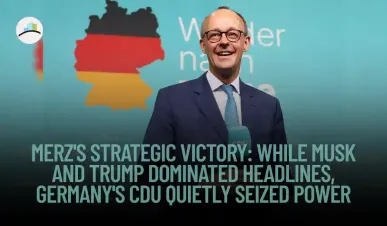
While global headlines were consumed by the ongoing Musk–Trump feud, Friedrich Merz of the Christian Democratic Union (CDU) emerged as Germany's next chancellor on June 6, 2025. His ascent, overshadowed by louder global narratives, marks a significant political shift in Europe, one that may redefine Germany’s relationship with both domestic far-right forces and global allies.
Background: The Rise of Merz
Friedrich Merz led the CDU/CSU alliance to secure the most seats in the Bundestag, despite facing coalition gridlocks in the initial parliamentary rounds. With his party now forming a government, Merz steps into the chancellorship, signaling a return to conservative governance in Germany.
Merz is known for his pro-business stance, fiscal discipline, and traditional European values. His political journey has seen him evolve from a corporate boardroom figure into a seasoned legislator capable of stitching consensus in a polarized climate.
The AfD Factor and Musk’s Endorsement
As Merz climbed the political ladder, the Alternative for Germany (AfD) party also saw its best-ever electoral performance, becoming the second-largest force in the Bundestag. This success is attributed, in part, to endorsements by Elon Musk, who labeled the AfD as "the only party that can save Germany."
Musk's public support triggered international media focus and reshaped the electoral narrative. However, Merz kept a calculated distance from AfD while benefiting from the splintered center-left vote.
Also read:
Merz’s Strategic Visit to the White House
In a calculated diplomatic move, Merz met with U.S. President Donald Trump. The visit, intended to reset EU–US ties, quickly became a media spectacle due to Trump's unexpected criticism of Elon Musk during the joint appearance.
Merz used the opportunity to advocate for greater European self-reliance. He highlighted the need for Europe to reduce dependency on American defense and trade frameworks, signaling a shift in Germany’s foreign policy focus.
Market and Political Reactions
Markets responded with minimal volatility. The euro held steady, while investors reacted positively to Merz’s expected fiscal discipline. Analysts noted that Germany under Merz would likely favor business-friendly reforms and tighter immigration policies.
Politically, Merz’s rise is seen as a stabilizing counterbalance to the AfD’s growing influence. His leadership is expected to consolidate the right-wing vote under a more moderate, centrist narrative.
A new Bromance? https://t.co/8x7ulrAPtm
— unseen1 (@unseen1_unseen) June 6, 2025
What Lies Ahead for Germany and Europe
Merz’s victory introduces the following possibilities:
-
Stronger emphasis on European autonomy in defense and policy
-
Reinforcement of transatlantic ties, but on more equal footing
-
Structural reforms in Germany’s energy and manufacturing sectors
-
A political strategy to marginalize far-right rhetoric without direct confrontation
Observers suggest Merz’s calm, strategic presence may allow Germany to reassert its leadership role within the European Union at a time of economic and geopolitical flux.
Source
CNBC – Musk vs. Trump Dominated, Yet Germany’s Merz Walked Away With a Win