
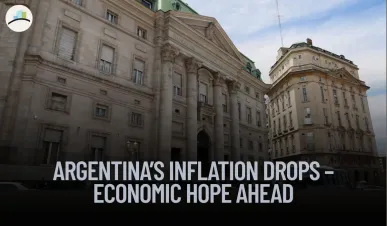
Argentina's long-standing battle with high inflation is showing promising signs of improvement, as the nation's central bank released fresh estimates pointing to a significant drop in annual inflation. According to the latest Market Expectations Survey (REM), the inflation rate is now projected to fall to 28.6% by the end of 2025—an encouraging revision from the previous month’s projection of 31.8%.
This comes as a notable departure from the sky-high inflation levels that surpassed 270% in 2024, signaling that recent economic reforms may be starting to take root. The revised forecast has added a layer of optimism among investors and economists monitoring the country’s financial recovery.
More Articles:
Improved Growth Outlook Signals Economic Rebound
In parallel with the inflation downgrade, economic analysts have also adjusted Argentina’s growth expectations slightly upward. Gross Domestic Product (GDP) is now anticipated to grow by 5.2% in 2025, up from a prior estimate of 5.1%.
While the uptick may seem modest, it marks a pivotal moment in the country’s macroeconomic outlook, reflecting the effects of tighter fiscal policy, stronger monetary controls, and more disciplined government spending.
What’s Driving the Turnaround?
Several factors have played a role in cooling inflation and fostering a more stable economic environment:
-
Renewed Access to Capital Markets: Argentina recently completed its first major sovereign debt offering in several years, raising approximately $1 billion through peso-denominated bonds. The offering saw robust investor interest, indicating rising confidence in the government's fiscal direction.
-
IMF Financial Support: The International Monetary Fund has backed Argentina’s reform plan with a $20 billion aid package. This influx of international support has provided the Central Bank with critical resources to manage inflation and stabilize currency volatility.
-
Stricter Fiscal Policy and Controlled Currency Devaluation: The Argentine government has rolled out a package of fiscal reforms, including trimming public subsidies, enforcing spending cuts, and reducing government payrolls. The Central Bank has also tightened control over the devaluation of the peso, easing its pace from 2% to 1% monthly. These steps have helped mitigate inflationary pressures tied to exchange rate instability.
📉🇦🇷 Argentina Slashes 2024 Inflation Forecast to 28.6%
— PiQ (@PiQSuite) June 5, 2025
Analysts cut inflation outlook as bond sale boosts confidence and IMF backs $20B loan deal.
Growth for 2025 revised slightly higher to 5.2% amid cooling price pressures. pic.twitter.com/fEBxnk78DD
Everyday Impact and Lingering Concerns
Despite the rosier macroeconomic projections, many Argentinians continue to feel economic pressure in their daily lives. Price increases, though slower, still affect essential goods and services. Combined with subsidy rollbacks and higher taxation, consumer sentiment remains cautious. The improvement in financial indicators is yet to fully translate into relief at the household level.
Experts warn that while the inflation trend is encouraging, sustained progress depends on continued policy discipline and external support. Any significant shift in commodity prices, political uncertainty, or global financial conditions could disrupt this fragile momentum.
Disclaimer
This article is based on publicly available economic forecasts and information originally reported by Reuters. The content has been independently restructured and analyzed by Procapitas for informational and editorial purposes only. It does not constitute financial or investment advice.
Source:
Reuters - Argentina inflation seen slowing to 28.6% by year-end



