
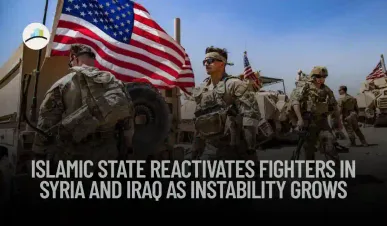
The Islamic State (IS) is capitalizing on regional instability in post-Assad Syria and parts of Iraq, reactivating fighters and sleeper cells, ramping up recruitment, distributing weapons, and plotting attacks. According to over 20 security, political, and coalition sources, these efforts are part of a deliberate campaign to rebuild capabilities in both countries .
Background: Chaos Creates Opportunity
Following the collapse of the Assad regime in December 2024, Syria has experienced heightened fragmentation and a governance vacuum. Militias, new factions, and shifting allegiances have created fertile ground for IS resurgence.
Read More on Procapitas:
IS commanders reportedly dispatched envoys from Raqqa to northern Iraq in December, instructing sleeper agents to establish operational cells—a move that intelligence services intercepted .
So far in 2025, IS claimed responsibility for 38 attacks in Syria—on pace for about 90 this year, still roughly one-third of last year’s total. In Iraq, they claimed only four attacks through May, down from 61 in all of 2024 .
Recent Attack Patterns
Surveillance has identified a surge in plot activity:
-
A suicide bomber was apprehended just before detonating in Daquq, northern Iraq, following a warning from captured envoys .
-
In Syria’s Suwayda region, IS detonated IEDs targeting transitional government and Free Syrian Army forces on May 22 and 28—the first such attacks in southern Syria since 2023 .
-
Remote desert strongholds remain active; US-led coalition conducted airstrikes in December 2024 targeting around 75 IS sites .
These episodes reflect a shift to urban operations and more sophisticated tactics, using silenced firearms and small explosive devices .
This is for those who say "they are not ISIS”.
— Shukri Hamk (@Yazidisto) November 30, 2024
Syria : ISIS is back stronger!
We need help, alot of genocides are on their ways. pic.twitter.com/QmiWnDkpR6
Government and Coalition Response
Syrian authorities under Ahmed al-Sharaa have enhanced intelligence operations in major cities like Aleppo, Homs, and Damascus. Defense Minister Murhaf Abu Qasra emphasized their security apparatus is expanding its capabilities .
In Iraq, enhanced drone surveillance and pre‑emptive security actions in the Hamrin Mountains and along vital transport routes have helped mitigate risks .
US-backed coalition forces have continued airstrikes and raids targeting IS remnants. Iraqi officials credited these pre‑emptive raids with preventing a broader resurgence .
Analysis: Risks & Resilience
Analysts caution that while IS lacks the territorial grip it held from 2014–2017, it retains resilience. SITE Intelligence’s director Rita Katz noted the group is likely entering a “re-strategising phase” rather than fading .
The UN estimates 1,500–3,000 IS fighters remain active across Syria and Iraq. Internal divisions and combat pressure may have reduced attack claims, but they are positioning for a comeback .
The US military withdrawal from Syria, approved by President Trump, risks destabilizing Kurdish-led detention camps housing up to 9,000 militants and families—potential escape routes and recruitment hubs .
Forward View: Coordinated Vigilance Needed
As foreign fighters reportedly re-enter Syria from Europe, security services in Damascus, Baghdad, and coalition partners must reinforce surveillance and inter-agency cooperation .
Key next steps include:
-
Continued intelligence sharing across Syrian, Iraqi, US, and European channels.
-
Expansion of surveillance, particularly in desert refuges and urban centers.
-
Sustained airstrikes and precision raids to disrupt IS cells and supply lines.
-
Support to local forces, including training, logistics, and counter-radicalization.



