
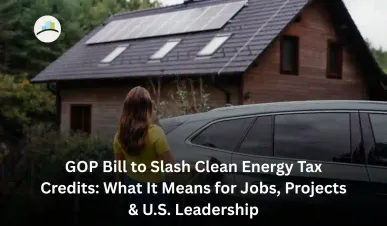
GOP’s Plan Could Cut Major Clean Energy Tax Credits — Here’s What That Really Means
So, here’s what’s happening. Republicans in Congress are working on a new bill that could pull back a lot of the support the government has been giving to clean energy projects. It’s called the “Big Beautiful Bill” — and depending on how it moves forward, it could seriously change how solar, wind, and electric vehicle projects get funded in the U.S.
The idea is to scale back or even totally end the tax credits that have helped make clean energy more affordable and attractive for businesses and investors. These credits came from the Inflation Reduction Act passed back in 2022, which was all about pushing the country toward greener energy. But now, GOP lawmakers say the country’s spending too much and they want to rein it in.
Read More:
The House and Senate Don’t Fully Agree
One of the most important things to understand is that the House and the Senate are not totally on the same page about this.
-
The House version of the bill is really strict. They want most clean energy tax credits gone within 60 days of passing the bill.
-
That means companies who were planning solar farms, wind power, or battery projects might have to cancel everything unless they’re already under construction.
-
The Senate version is more flexible. They’re okay with keeping some credits for things like geothermal, hydro, and battery storage through 2035.
-
But even in the Senate’s version, support for solar and wind would start to disappear after 2026 and be completely gone by 2028.
So, the Senate is trying to take a softer approach, but it still means big changes for clean energy development either way.
House, Senate tax bills both end many clean energy credits: 'It's just a question of timeline,' expert says https://t.co/SNybZSK6rm
— CNBC (@CNBC) June 20, 2025
New Rules Could Make Building Projects Way Tougher
There’s another catch. Under this bill, any new clean energy project would need to start construction by the end of 2025 to even qualify for any tax credits at all.
Even then, the amount of credit drops every year:
-
In 2026, you get 60% of the original credit.
-
In 2027, that drops to 20%.
-
By 2028, it's basically gone.
Also, the bill makes it harder for companies to transfer tax credits, which has been one of the main ways clean energy businesses have funded large projects. That could mean fewer deals get made and less investment coming in.
Sourcing Restrictions Add More Pressure
Another part of the bill adds strict rules on where materials come from. If a clean energy project uses parts made in countries like China or Russia, it might not qualify for any tax credit at all.
Now that may sound reasonable on paper, but in real life, a lot of the parts for solar panels and batteries do come from those countries. Changing that suddenly could make projects way more expensive and harder to pull off.
It could even lead to delays or cancellations just because companies can’t source materials quickly enough from approved locations.
Investors and Companies Are Getting Nervous
Clean energy stocks dropped soon after word got out about what’s in the Senate’s version of the bill. Companies like Enphase and Sunrun saw their shares fall. And honestly, it makes sense — if a major source of support is taken away, of course people will be worried.
-
The industry has been growing fast the past few years.
-
These tax credits helped create thousands of jobs and brought billions of dollars into local communities.
-
If that support is pulled back suddenly, a lot of those jobs and investments could disappear just as fast.
Clean energy companies are already saying that this bill could lead to layoffs and force them to cancel future expansion plans.
Other Countries Are Still Moving Forward
This is where things get tricky. While the U.S. is thinking about stepping back, countries like Canada, China, and those in the EU are doubling down on clean energy. They’re investing even more into battery tech, green hydrogen, and carbon capture.
If the U.S. pulls back now, it could start falling behind in industries that might define the next 20–30 years. That’s not just about climate — it’s also about economics and global leadership. A lot of people worry that this bill could put the U.S. at a major disadvantage.
The Politics Are Messy
There’s even some disagreement within the Republican party itself. Some GOP senators from states that have really benefited from clean energy jobs are now worried. They’re getting calls and messages from:
-
Environmental groups
-
Business leaders
-
Tech companies
...and most of them are saying the same thing: rolling back these tax credits could do more harm than good.
There’s also the issue of what can legally be passed under the Senate’s “reconciliation” process. Some parts of the House bill, like targeting the Consumer Financial Protection Bureau or reversing Biden’s vehicle rules, might not even be allowed under Senate rules. That could mean more back-and-forth over what stays and what gets cut.
So, What Happens Next?
Right now, both the House and the Senate are working on final versions of the bill. They want to get something passed before July 4, but it’s not clear what that final version will look like.
Will they stick with the strict rollback? Will the Senate’s softer version win out? No one’s totally sure.
But what we do know is this: the outcome of this bill could seriously shape the future of clean energy in America. And a lot of companies, workers, and even small towns are waiting to see what comes next.



